.svg?w=384)

Quick answer: Thicker acoustic panels soak up deep, bassy sounds, so they help with boomy bass and music rooms. For rooms used mainly for talking (offices, restaurants, classrooms, churches), standard panels are usually enough because speech sits in the mid range. Go thicker, or add bass traps (thick corner panels that soak up deep, boomy sound), for studios, home cinemas, drum rooms and small rooms that sound boomy.
Key takeaways
- Thicker = reaches deep, bassy sounds.
- Speech rooms: standard thickness is plenty.
- Music and bass problems: thicker panels or bass traps in corners.
Why does thickness matter?
Deep-sound sound has long wavelengths and passes through thin material without losing much energy. A thicker panel (or a panel spaced off the wall) gives low notes more material to pass through, so it soaks them up better. Our Flexi™ panels come in 25 mm (NRC (a score from 0 to 1 for how much sound a panel soaks up) 0.80) and 50 mm (NRC 1.00).
When are standard panels enough?
Offices, meeting rooms, restaurants, classrooms and church halls. The goal is clear speech, which sits in the mid range that standard panels handle well. Spending on more panels in the right places helps more than going thicker. See NRC ratings.
Not sure what your room needs? Send us a photo on WhatsApp or request a free quote. We'll tell you how many panels, where they go and the price. See our acoustic panels Singapore and recent projects.
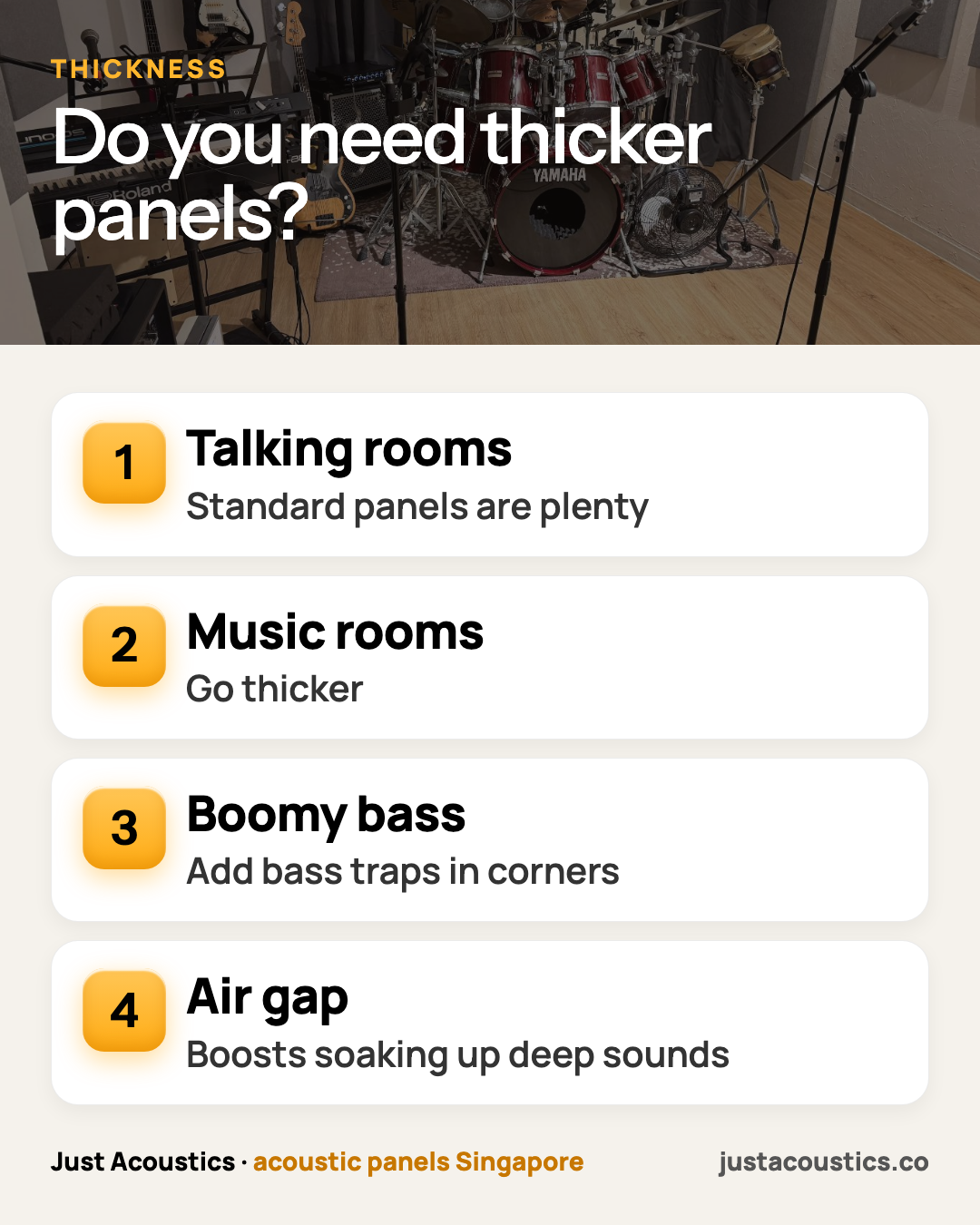
When should I go thicker?
- Home studios and mixing rooms.
- Home cinemas with subwoofers.
- Drum and band rooms.
- Small bedrooms that sound boomy.
In these, combine standard panels with bass trap panels in the corners. See do I need bass traps?.
Is spacing panels off the wall worth it?
Yes. A gap behind a panel improves soaking up deep sounds without buying a thicker panel. It's common in studios; in offices it's rarely needed.
A simple way to decide
Ask: is the problem voices or bass? If people struggle to understand each other, standard panels. If the room booms, or notes sound uneven, thickness and bass traps.
What we see on real jobs
In offices and restaurants the problem is voices, so standard panels do the job. In home studios and drum rooms, corners and bass traps make the difference, which is where thickness pays off.
Get a straight answer for your room
Send us a photo or a short video of the room on WhatsApp (+65 8930 1905). We'll reply with whether panels are the right fix, how many you need, where they go and the price. If it's really a soundproofing problem, we'll tell you.
WhatsApp us a photo · Request a free quote · See prices
Related reading