.svg?w=384)

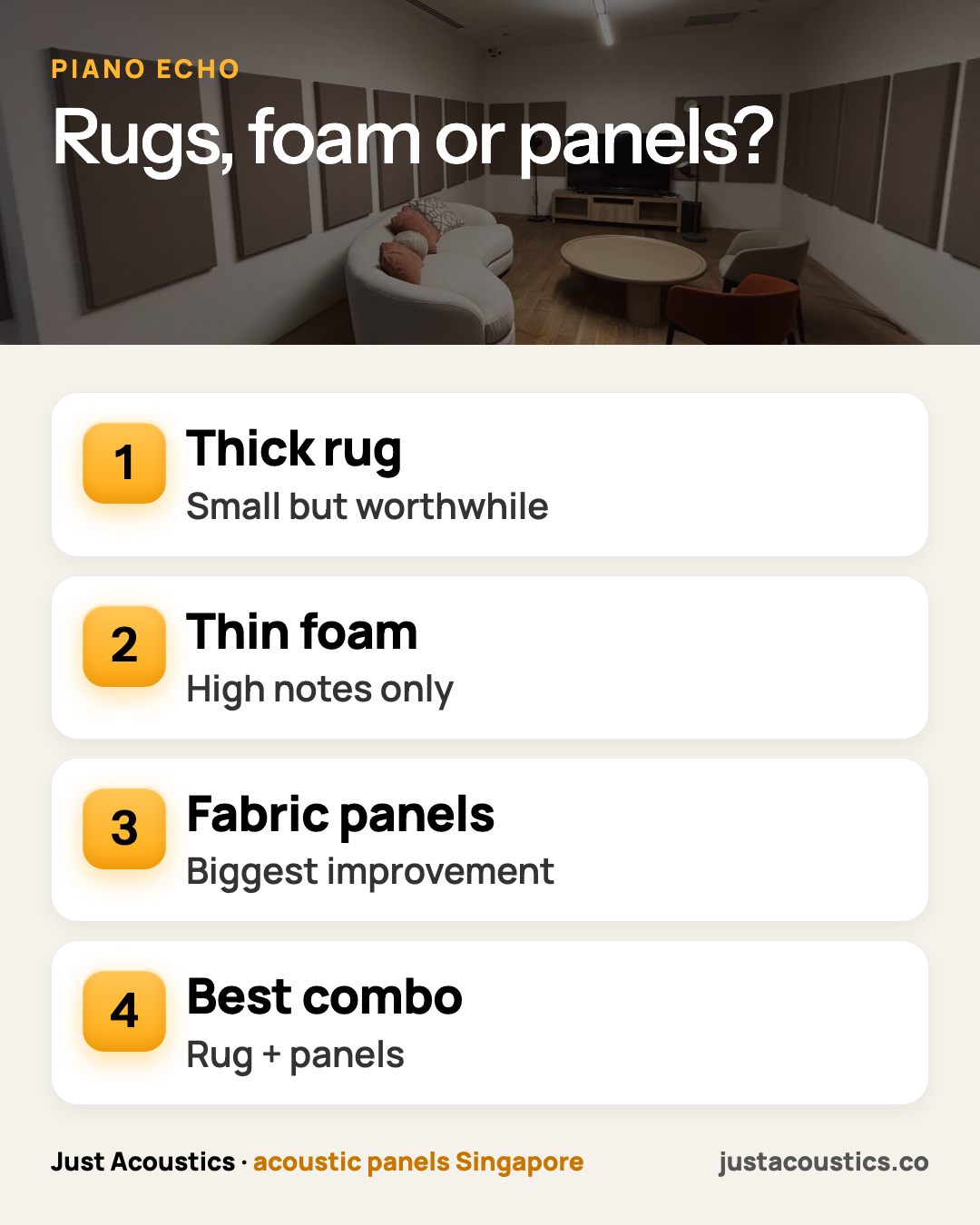
Quick answer: Rugs and mats help piano echo a little, mostly by stopping sound bouncing off a hard floor. Thin foam on the wall takes off some harsh high notes but leaves the body of the echo. Fabric acoustic panels on the walls do the most. The best combination is a thick rug under the piano plus panels on the walls near and opposite it.
Key takeaways
- Rug: a small but worthwhile improvement on tiles.
- Foam: high notes only.
- Panels + rug: the combination that works.
What does a rug do?
It softens floor echoes and reduces footstep and pedal noise. A thick rug with an underlay works better than a thin mat. It does nothing for the walls, where most of the echo comes from.
What helps piano echo
- Thick rug + underlay · Effect: Softens floor bounce · Worth it?: Yes
- Thin mat · Effect: Very small · Worth it?: A little
- Thin foam · Effect: Takes off harsh highs · Worth it?: Limited
- Fabric panels · Effect: Reduces echo across range · Worth it?: Yes
- Anti-vibration pads · Effect: Less vibration into the floor · Worth it?: Not a neighbour fix on its own
What does foam do?
Thin foam soaks up mostly high-pitched sounds. The piano sounds less bright but still echoey. Foam also tends to look temporary in a living room. See foam vs panels.
Not sure what your room needs? Send us a photo on WhatsApp or request a free quote. We'll tell you how many panels, where they go and the price. See our acoustic panels for homes and recent projects.
What do panels do?
Soak up across more of the piano's range on the walls where echoes come from. Start with the wall the piano faces and the wall behind the player. A small room usually needs 6–10 panels. See piano room acoustic treatment.
What about anti-vibration pads?
Caster cups and pads under the piano reduce vibration into the floor. They do not stop the unit below hearing the piano on their own. They don't change echo in your room either.
What we see on real jobs
A rug and foam help a little, but the room still rings. Adding panels on the two walls nearest the piano is what makes practice comfortable.
Get a straight answer for your room
WhatsApp a photo of the room (+65 8930 1905) and tell us what you use it for: calls, TV, music or mixing. We'll suggest a layout, a colour and a price, including no-drill options where your walls allow.
WhatsApp us a photo · Request a free quote · See prices
Related reading