.svg?w=384)
Quick answer: Acoustic treatment reduces echo inside a room so speech and music sound clearer. Soundproofing stops sound passing in or out of a room. If the room sounds loud or echoey with only your own people in it, you need acoustic treatment. If you can hear the neighbours or traffic, you need soundproofing.
Key takeaways
- Treatment = soft panels that soak up echo inside the room. Soundproofing = mass and seals that block sound between rooms.
- Most offices, restaurants, churches and homes in Singapore need treatment, not soundproofing.
- A soundproofed room can still echo, and a treated room can still leak. They are separate problems.
What is the difference in one sentence?
Soundproofing stops sound getting in or out; acoustic treatment controls sound once it is inside. They use different materials, different budgets and different trades. Soft panels soak up echo, while seals, solid doors and walls built up to the slab block sound.
Acoustic treatment vs soundproofing at a glance
- Fixes · Acoustic treatment: Echo, muddy speech, harsh rooms · Soundproofing: Noise getting in or out
- How · Acoustic treatment: Soft absorptive panels on walls and ceiling · Soundproofing: Mass, seals, double walls, special doors and glass
- Disruption · Acoustic treatment: Mounted onto existing surfaces · Soundproofing: Construction work
- Cost · Acoustic treatment: Lower, priced per panel · Soundproofing: Much higher, priced per project
- Typical users · Acoustic treatment: Offices, restaurants, churches, homes, schools · Soundproofing: Recording booths, music rooms, shared walls
How do I tell which one I need?
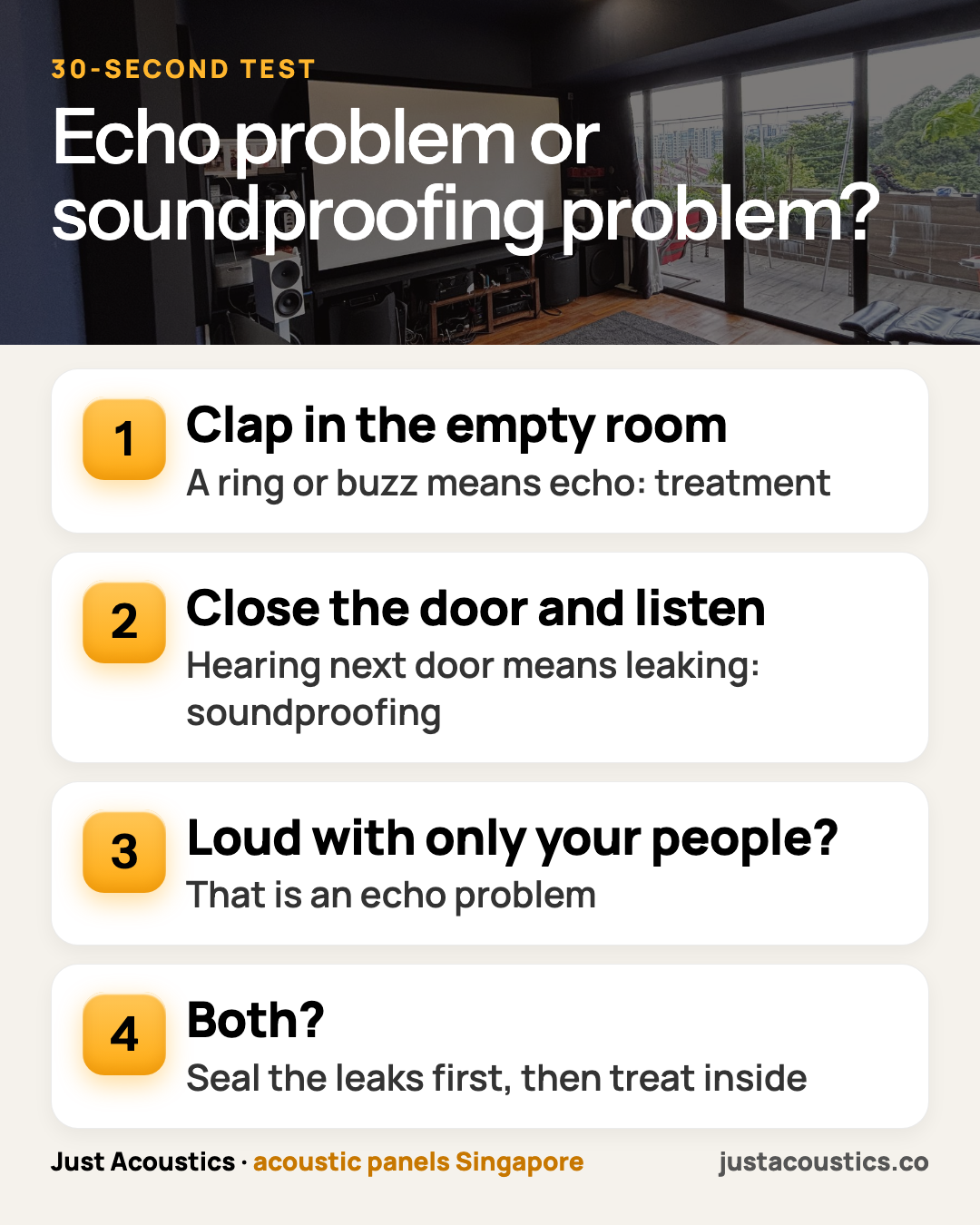
Do this 30-second test:
- Clap once in the empty room. Hear a ring, buzz or tail? That's echo, a treatment problem.
- Listen with the door shut. Can you clearly hear the next room, the corridor or traffic? That's sound leaking, a soundproofing problem.
- Ask when it's worst. Loud even with only your own team or family inside? Treatment. Loud because of someone else? Soundproofing.
Not sure what your room needs? Send us a photo on WhatsApp or request a free quote. We'll tell you how many panels, where they go and the price. See our acoustic panels Singapore and recent projects.
Why do most Singapore spaces need treatment?
Singapore fit-outs love hard finishes: polished concrete, glass partitions, tiles, exposed ceilings and bare plaster in HDB and condo rooms. All of them bounce sound. In these rooms the usual problem is clarity (calls, sermons, conversation at dinner), not noise coming through a wall. That is a treatment job. More on whether acoustic panels really work.
How do cost and construction compare?
Acoustic treatment is mounted onto your existing walls and ceiling, with no hacking and little downtime. It's priced per panel. See acoustic panel prices.
Soundproofing usually means building work: denser or double walls, sealed doors and gaps, sound-rated glazing, and dealing with air-con ducts. It costs far more and takes longer, and in rented or strata spaces it often needs approvals.
When do you need both?
Some rooms have both problems: a podcast studio next to a busy corridor, a music room in a condo, or a glass meeting room that leaks and echoes. In those cases, fix the leaks first (seals, doors, glazing) and then treat the inside. For noise from next door specifically, read can acoustic panels help with neighbour noise?.
What does soundproofing involve in a Singapore unit?
Real soundproofing works on three things. Mass: heavier walls and boards block more sound. Airtightness: sound leaks through any gap, so doors get seals and drop-down thresholds, and penetrations for pipes and cables are sealed. Separation (decoupling): a second wall or ceiling on resilient mounts stops vibration travelling through the structure.
In practice that can mean a new partition, a solid-core acoustic door, laminated or double glazing, and closing the gap above a false ceiling where sound travels over the top of a meeting-room wall. In HDB flats and condos, much of this needs approval, and in rented offices it usually needs the landlord's agreement. That's why it costs far more than mounting panels, and why it's worth confirming you actually have a leaking problem before paying for it.
Quick check: which symptoms point to which fix?
- "Calls sound hollow." → Echo → acoustic treatment.
- "The restaurant roars at 8pm." → Echo build-up → acoustic treatment.
- "We can hear the meeting next door." → Leakage → soundproofing (seal the ceiling gap and door first).
- "The neighbour's TV comes through the wall." → Leakage → soundproofing.
- "Our drummer upsets the whole block." → Leakage → soundproofing, then treatment inside for the sound of the room.
What we see on real jobs
The word "soundproofing" is often used for what is really an echo problem: a glass meeting room that sounds hollow on calls, or a church hall where the back row can't follow the sermon. We'll always tell you which one it is, even if the answer is that panels won't solve it.
Get a straight answer for your room
Send us a photo or a short video of the room on WhatsApp (+65 8930 1905). We'll reply with whether panels are the right fix, how many you need, where they go and the price. If it's really a soundproofing problem, we'll tell you.
WhatsApp us a photo · Request a free quote · See prices
Related reading