.svg?w=384)

Quick answer: Most rooms need acoustic panels covering 20–40% of their hard wall and ceiling area. For a typical 20 m² meeting room that is about 13 m², or 16–20 standard 1200 × 600 mm panels. Rooms with glass, tiles, high ceilings or lots of people need the higher end of that range.
Key takeaways
- Rule of thumb: treat 20–40% of the hard surfaces, not the whole room.
- Count = hard surface area × coverage % ÷ panel size (0.72 m² for a 1200 × 600 mm panel).
- Where you put the panels matters as much as how many you buy.
What is the rule of thumb?
Treat 20–40% of the room's hard surfaces (walls and ceiling that are glass, concrete, plaster, tiles or timber).
- Light echo: around 15%.
- Most offices, [meeting rooms](/blog/how-many-acoustic-panels-for-meeting-room) and [classrooms](/blog/reduce-echo-training-room-classroom-singapore): 20–25%.
- Restaurants, gyms, halls and high ceilings: 25–35%.
Carpet, curtains, sofas and full bookshelves already soak up some sound, so you don't count those surfaces.
How do I work it out for my room?
- Measure the room: length, width and height.
- Work out the hard surface area: all four walls plus the ceiling, minus doors and anything already soft.
- Multiply by your coverage: 0.20 for most rooms, 0.30–0.40 for loud or high-ceiling spaces.
- Divide by the panel size. A 1200 × 600 mm panel is 0.72 m².
Worked example: a 5 m × 4 m meeting room, 2.8 m high. Walls: (5 + 4 + 5 + 4) × 2.8 = 50.4 m². Ceiling: 20 m². Minus about 6 m² of glass door and window = about 64 m² of hard surface. At 20% you need about 13 m² of panels, which is about 18 panels. In practice we would fit 16–20, split between the walls and a ceiling cloud.
Not sure what your room needs? Send us a photo on WhatsApp or request a free quote. We'll tell you how many panels, where they go and the price. See our acoustic panels Singapore and recent projects.

How many panels by room type?
Use these as starting points. Your finishes and ceiling height can move the number up or down. The exact count for your room is confirmed from photos.
Typical panel counts (1200 × 600 mm panels)
- Small meeting room · Size: 10–15 m² · Typical panels: 6–10
- Tuition or training classroom · Size: 20–30 m² · Typical panels: 10–16
- Home studio or podcast room · Size: 10–15 m² · Typical panels: 8–14 + bass traps (thick corner panels that soak up deep, boomy sound)
- Open-plan office · Size: 50–100 m² · Typical panels: 25–50, mostly ceiling
- Restaurant or café · Size: 80–150 m² · Typical panels: 30–60
- Church hall · Size: 150 m² + · Typical panels: 40+, walls and ceiling
Does placement matter more than the number?
Yes. Ten panels in the right places beat twenty in the wrong ones. Start with the walls closest to where people sit and talk, then any bare walls facing each other, then the ceiling in big or tall rooms. Full guide: where to place acoustic panels first.
What are the common mistakes?
- Covering one wall only, so sound still bounces between the other three.
- Buying thin foam that only soaks up high notes. See are thicker panels better?.
- Skipping the ceiling in restaurants and halls, where it is often the biggest reflector.
- Treating 100% of the walls, which can make a room feel flat.
What we see on real jobs
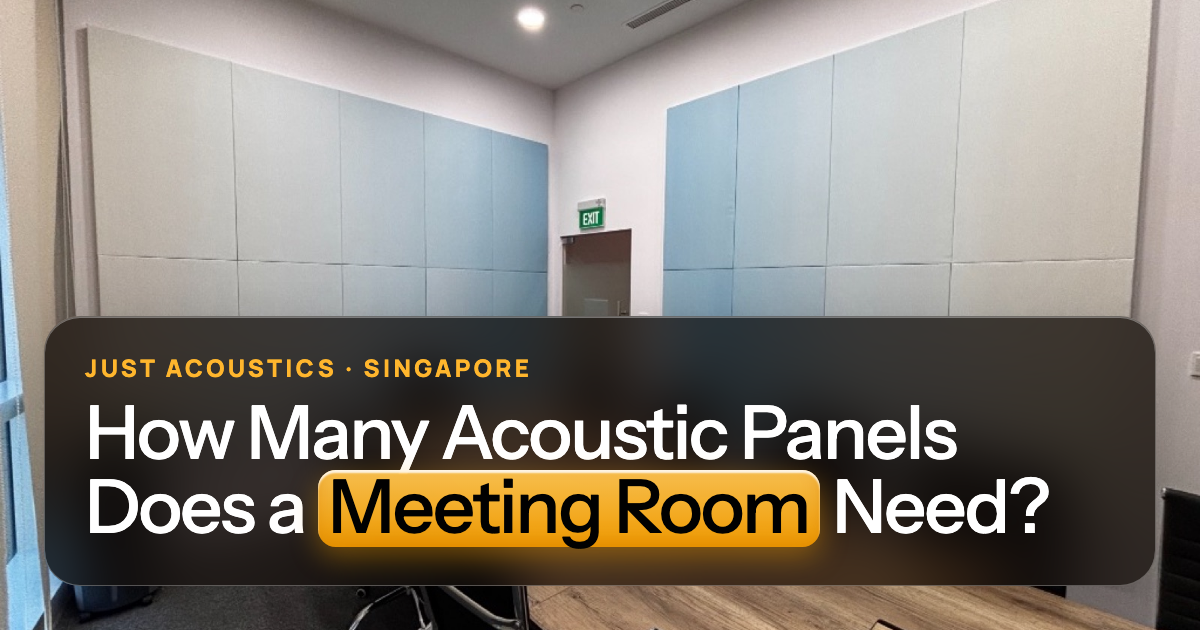
When we quote from photos, the two things that change the count most are the ceiling and the glass. A meeting room with a glass wall and a concrete ceiling needs more coverage than a plastered room of the same size, because both surfaces reflect almost everything. At Capital Asia Investments in SBF Centre, we used both wall and ceiling panels in three meeting rooms.
Get a straight answer for your room
Send us a photo or a short video of the room on WhatsApp (+65 8930 1905). We'll reply with whether panels are the right fix, how many you need, where they go and the price. If it's really a soundproofing problem, we'll tell you.
WhatsApp us a photo · Request a free quote · See prices
Related reading