.svg?w=384)
Quick answer: Fabric acoustic panels work better than thin acoustic foam for most rooms. Thin foam (the egg-crate kind) mainly soaks up high-pitched sounds, so rooms end up dull but still boomy and echoey in the voice range. Thicker, denser fabric panels soak up across more of the range, last longer, look better and usually come with fire paperwork for commercial use.
Key takeaways
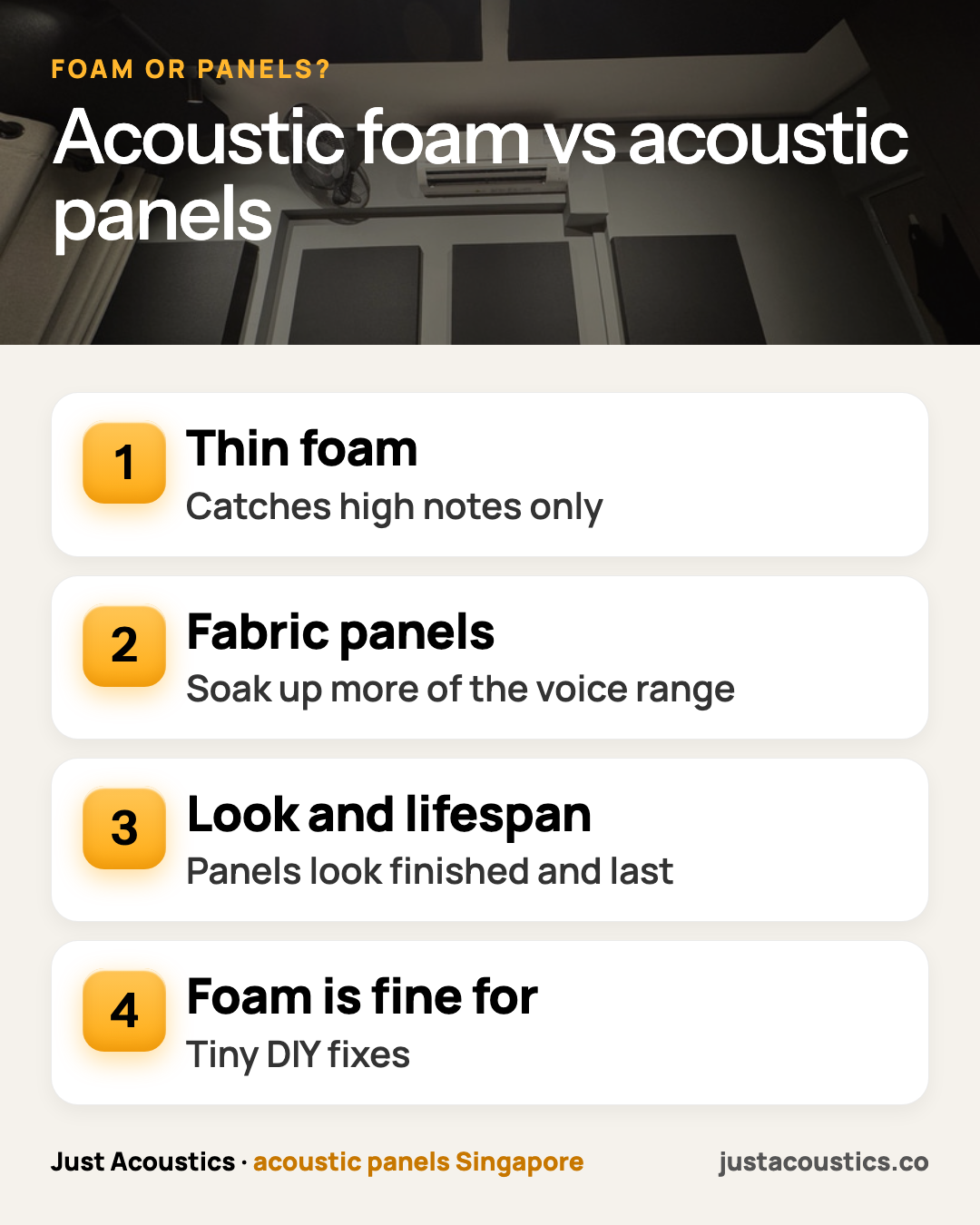
- Thin foam = high-pitched sounds only; the muddy part stays.
- Fabric panels with a dense core soak up more of the voice and music range.
- Foam is fine for small DIY fixes; panels for anything you want to look and work right.
Why does cheap foam disappoint?
- It's thin. Most foam tiles are 2–5 cm; low and middle sounds like voices pass straight through.
- It's light. Low density means less absorption (how much sound gets soaked up) below the treble.
- It looks temporary. Fine in a hobby room, wrong in a restaurant or office.
- It degrades. Many foams yellow, crumble and collect dust over time.
- Commercial buildings often need fire paperwork that cheap foam can't provide.
What do fabric panels do differently?
A dense porous core, usually thicker than foam tiles, wrapped in acoustically transparent fabric. It soaks up more of the voice range, which is what makes rooms sound clearer. Our Flexi™ panels are rated up to NRC (a score from 0 to 1 for how much sound a panel soaks up) 1.00. See what is an NRC rating?.
Not sure what your room needs? Send us a photo on WhatsApp or request a free quote. We'll tell you how many panels, where they go and the price. See our acoustic panels Singapore and recent projects.
Foam vs fabric panels
- Soaks up · Thin acoustic foam: Mostly high-pitched sounds · Fabric acoustic panels: Wider range incl. voice
- Look · Thin acoustic foam: Studio/temporary · Fabric acoustic panels: Finished, 39 colours
- Lifespan · Thin acoustic foam: Can yellow and crumble · Fabric acoustic panels: Long-lasting
- Commercial use · Thin acoustic foam: Often lacks fire docs · Fabric acoustic panels: Specs available
- Best for · Thin acoustic foam: Tiny DIY fixes · Fabric acoustic panels: Homes, offices, F&B, churches
When is foam good enough?
- A small vocal booth or desk setup on a tight budget.
- Patching flutter echo (a fast, ringing echo between two bare walls) in a tiny room.
- Temporary setups you'll throw away.
Is foam cheaper in the end?
Per tile, yes. But thin foam leaves the echo in the voice range, so the room may still need panels afterwards. If the room matters, panels are usually cheaper overall, from S$185 each installed. See panel prices.
What we see on real jobs
Thin foam on one wall makes a room sound different but not better. It takes the sparkle off the sound and leaves the boom and the voice-range echo.
Get a straight answer for your room
Send us a photo or a short video of the room on WhatsApp (+65 8930 1905). We'll reply with whether panels are the right fix, how many you need, where they go and the price. If it's really a soundproofing problem, we'll tell you.
WhatsApp us a photo · Request a free quote · See prices
Related reading