Quick answer: In a bilingual or multilingual service, the congregation hears two voices: the preacher and the interpreter. Echo smears both, and older members or those in their second language struggle most. Acoustic panels on the rear and side walls shorten the echo so each sentence ends cleanly before the next begins. This helps on-stage interpretation, headset interpretation and recordings.
Key takeaways
- Two voices make echo twice as confusing.
- Panels let each sentence end cleanly.
- Older members and second-language listeners benefit most.
Why is interpretation harder in an echoey room?
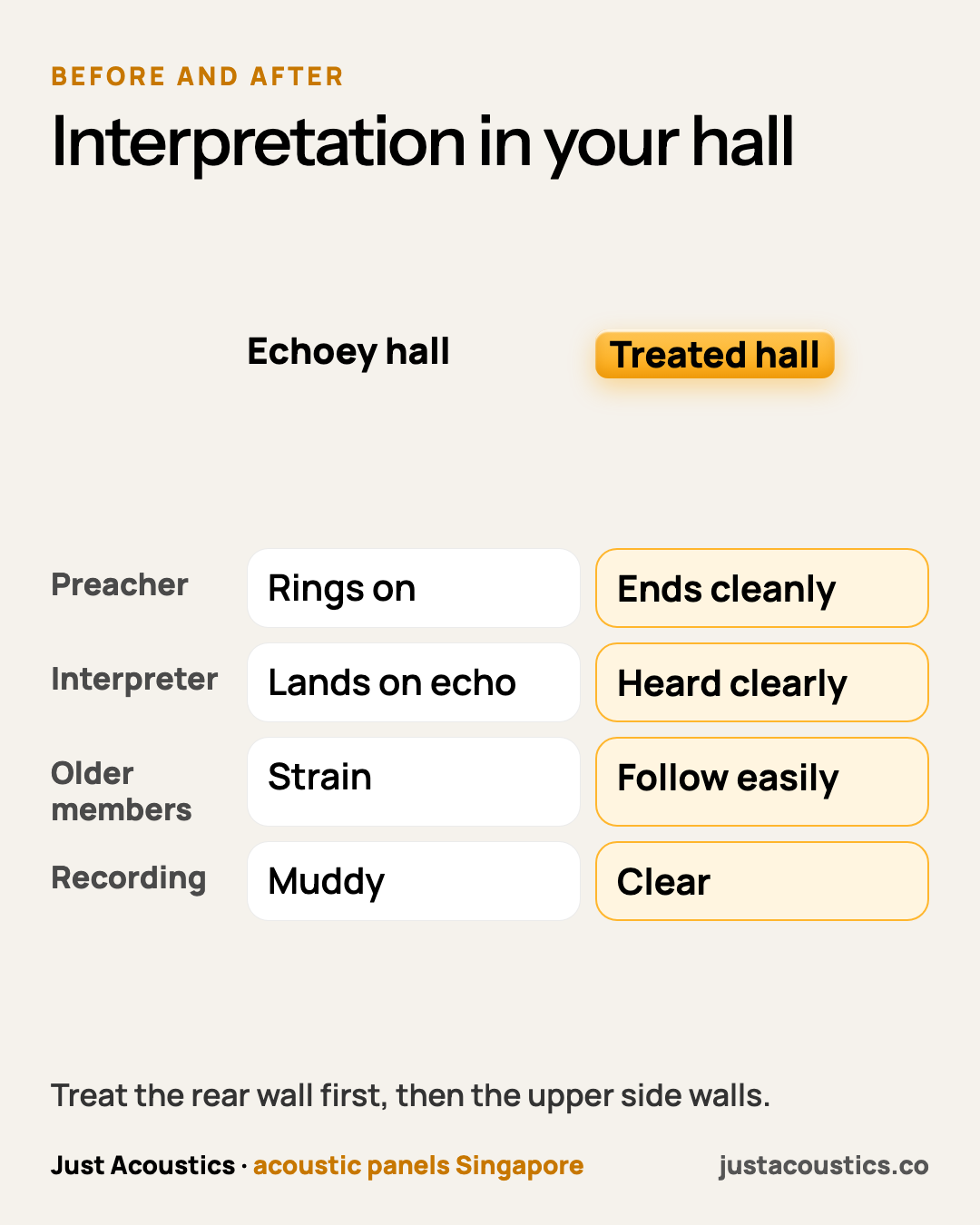
In on-stage interpretation, the preacher says a sentence and the interpreter repeats it. If the room still rings with the first voice, the second voice lands on top of it. Listeners then hear a blur of two languages. This is tiring for everyone and hard for older members.
Who struggles most?
People listening in their second language need every word clear, as they cannot guess missing words easily. Older members and those with hearing loss struggle in echo too. Children in the service also lose focus faster when speech is muddy. See church acoustic treatment in Singapore.
Not sure what your room needs? Send us a photo on WhatsApp or request a free quote. We'll tell you how many panels, where they go and the price. See our church acoustics and recent projects.
Where do panels help most?
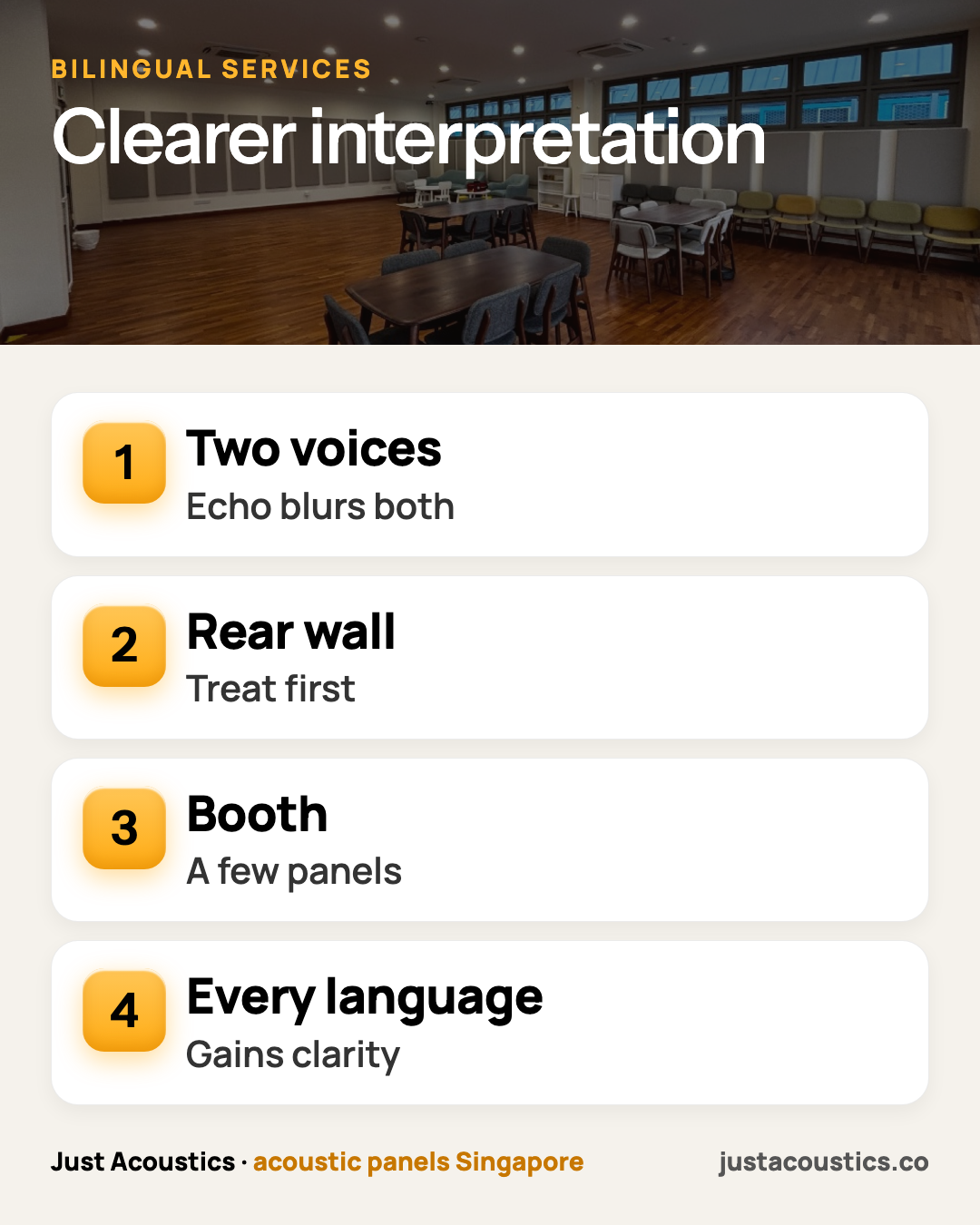
The rear wall facing the stage is the main problem, as it sends both voices straight back. Upper side walls are next, especially in long halls. If your church uses a separate interpretation room or booth, treat that small room too so the interpreter hears the preacher clearly. See where to place acoustic panels first.
What about headset interpretation?
Some churches give headsets to those who need another language. Even then, the interpreter must hear the preacher clearly from the room or a feed. A small booth or corner with a few panels keeps their mic free of room echo. The main hall still benefits from panels for everyone not on headsets.
Does this help Mandarin and dialect services?
Yes. Tonal languages like Mandarin, Hokkien and Cantonese rely on clear vowel shapes and tones, which echo blurs. Clearer rooms help every language, but tonal speech often gains a lot. The goal is simple: each word ends before the next starts.
What will it cost?
A worship hall of about 20 × 12 m usually needs around 152 to 206 panels, about S$28,000 to S$38,000 installed at S$185 each. A small interpretation booth may only need a handful of panels, similar to a home office of 4 to 6 panels, about S$740 to S$1,110 installed. We confirm the count from photos for free. See acoustic panel prices.
Interpreter position on stage
Keep the interpreter close to the preacher and on a separate mic, so the sound team can balance both voices. Short sentences from the preacher give the interpreter clean gaps to speak into. Less echo means those gaps stay clear.
Recordings and sermon podcasts
A treated room makes both languages cleaner on recordings, so online listeners follow more easily. Take the recording feed from the mixing desk, not a camera mic. The less echo the mics pick up, the less editing each sermon needs.
What we see on real jobs
In a multilingual service, every point is spoken twice. A clearer room makes the interpreter's job much easier.
Get a straight answer for your room
Send us a short video of your hall during a service or rehearsal on WhatsApp (+65 8930 1905). We'll suggest where to start, how to phase it and what it costs, and schedule work around your services.
WhatsApp us a photo · Request a free quote · See prices
Related reading