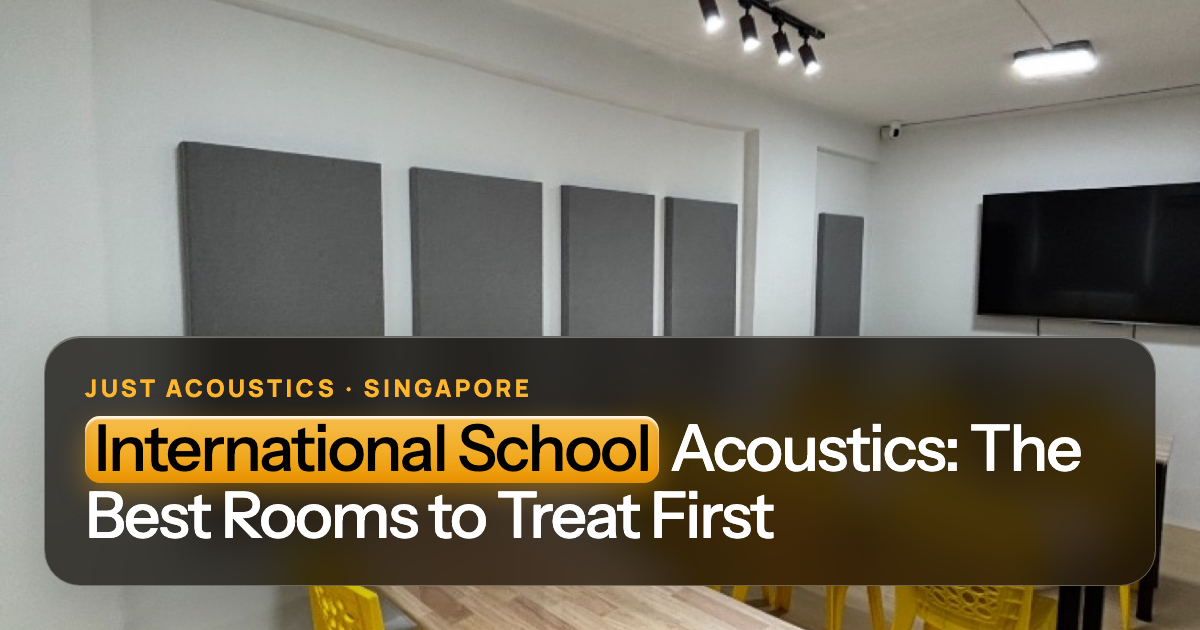
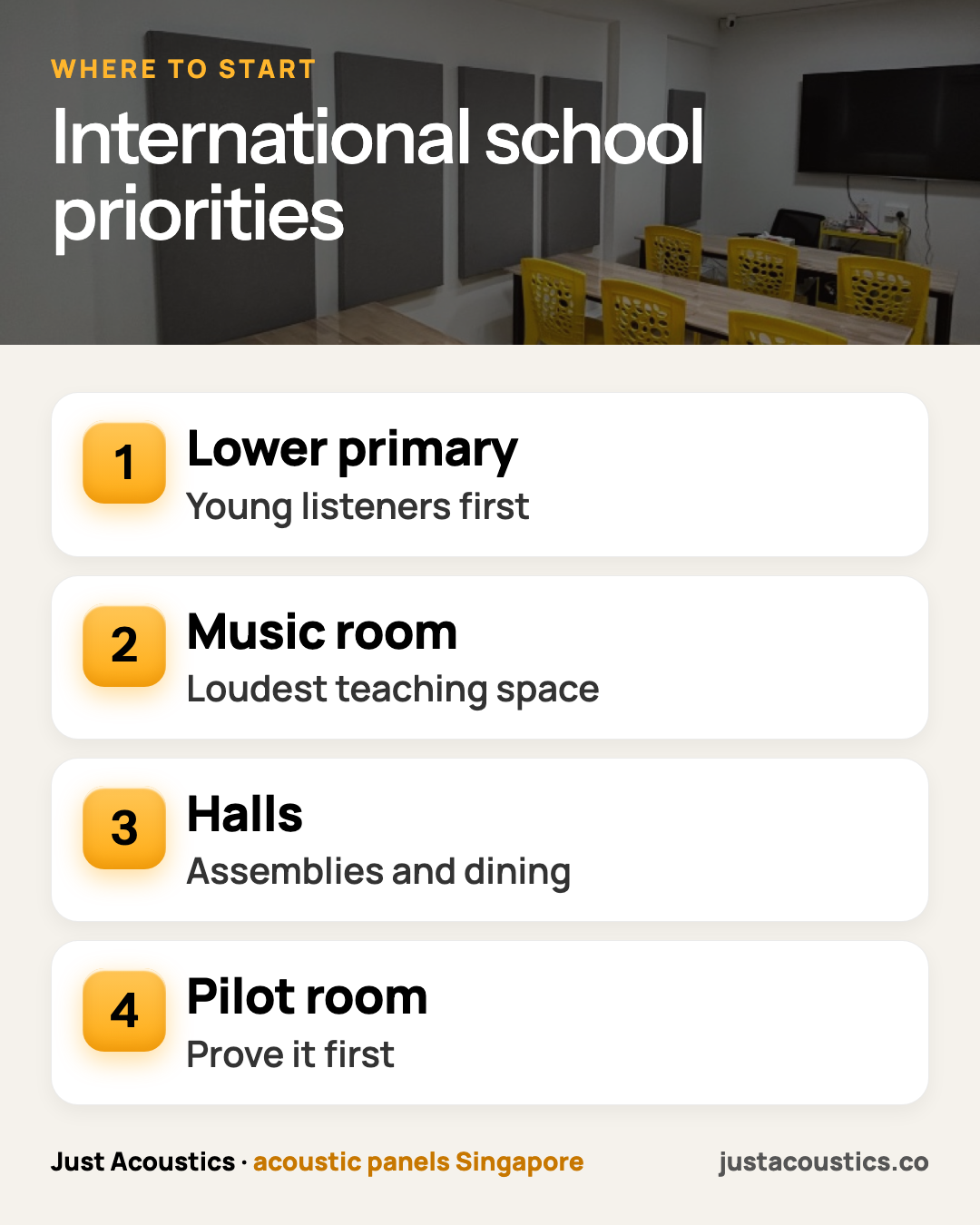
Quick answer: In most international schools, the best rooms to treat first are the ones where speech matters most and echo is worst: lower primary classrooms, the music room, the dining hall and the main hall. Start with one pilot classroom, check the difference, then roll out. A typical 8 × 6 m classroom needs 20 to 28 panels, about S$3,700 to S$5,180 installed.
Key takeaways
- Treat rooms where speech matters most first.
- Pilot one classroom before rolling out.
- A classroom is about S$3,700 to S$5,180 installed.
Which rooms should come first?
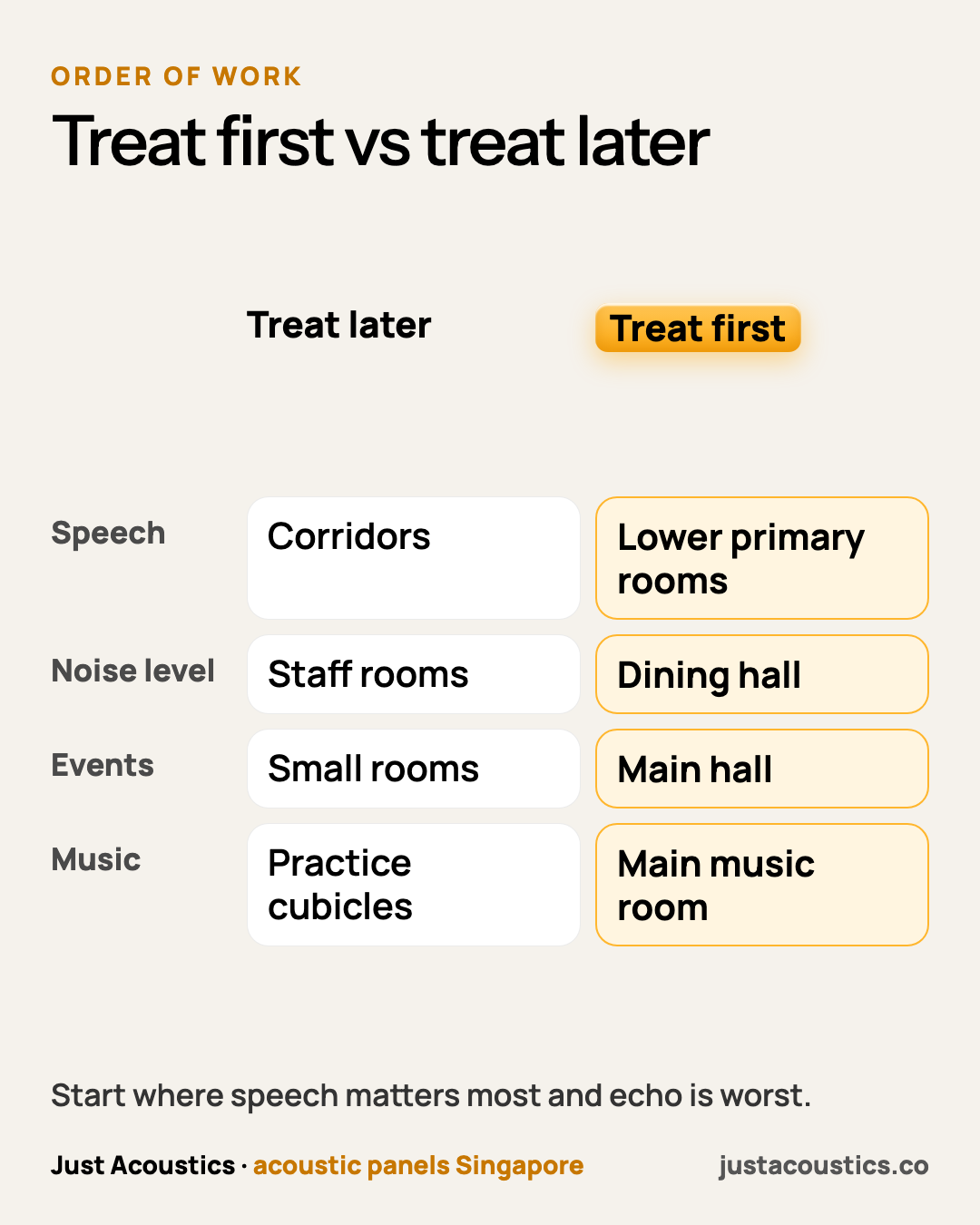
Start with lower primary classrooms, where young children are still learning to listen and read. Then the music room, the dining hall and the main hall, which are usually the loudest. Corridors and stairwells can come later. Staff rooms and meeting rooms matter too, but they rarely top the list.
Why do new school buildings echo so much?
Modern schools love hard, clean finishes: painted concrete, glass, vinyl floors and high ceilings. These surfaces bounce sound around the room. Add 25 children and an aircon unit, and the teacher has to talk over the noise. See how to reduce echo in a classroom.
Not sure what your room needs? Send us a photo on WhatsApp or request a free quote. We'll tell you how many panels, where they go and the price. See our acoustic panels for schools and recent projects.
How many panels does each room need?
A rough guide is 20–40% of the wall area, or 20 to 40 percent. For an 8 × 6 m classroom that is 20 to 28 panels. A main hall needs far more and is often priced per square metre, at about S$255 per m² installed. See how many panels you need.
What does a whole-school programme cost?
Panels cost from S$185 each, supplied and installed (50 mm, standard fixings included). Ten classrooms at 24 panels each is 240 panels, about S$44,400. Scaffolding for halls and night or Sunday work are quoted separately. You can spread this over two or three terms.
Should we run a pilot room?
Yes. Treat one classroom first and invite teachers to teach in it for a few weeks. Their feedback is the best evidence you can give a board. It also lets you test colours and layout before you order for every room.
Where do panels go in a classroom?
On the back wall, facing the teacher, and on the upper side walls above display boards. If the ceiling is high and hard, ceiling panels help a lot. Ceiling panels are always fixed mechanically, never glued.
What panels will not do
Panels stop echo inside a room. They do not stop noise from the field, the road or the classroom next door. If sound leaks through walls or doors, that needs building work, not panels. See acoustic treatment vs soundproofing.
Fire and safety papers
Flexi panels are fire safe and formaldehyde safe. Facilities teams usually want these documents on file before work starts. We send our product papers early and coordinate with your side and any third-party consultants for fire papers and QP/PE sign-off.
Planning around the calendar
Book halls and big rooms for school holidays. Classrooms take a few hours each, so they can often be done after dismissal. Panels are made to order in about 4–6 weeks, so order well before the holidays start.
What we see on real jobs
Lower primary rooms and halls have hard finishes and many young voices, so they are often the loudest spaces. A pilot room gives teachers something real to judge.
Get a straight answer for your room
Send a photo of the classroom or studio on WhatsApp (+65 8930 1905) with its rough size. We'll recommend panels for clearer lessons and schedule installation around your classes or school holidays.
WhatsApp us a photo · Request a free quote · See prices
Related reading
- Acoustic panels for schools
- Reduce echo in a classroom
- How many acoustic panels do I need?
- Acoustic panel prices in Singapore
- What happens during a site visit
- Prices and installation
- Our projects
- Flexi™ acoustic panels (39 colours)
- Get a free quote
- Are Acoustic Panels Safe for Kids' Rooms and Preschools?
- How Much Does It Cost to Fix Classroom Echo in Singapore?