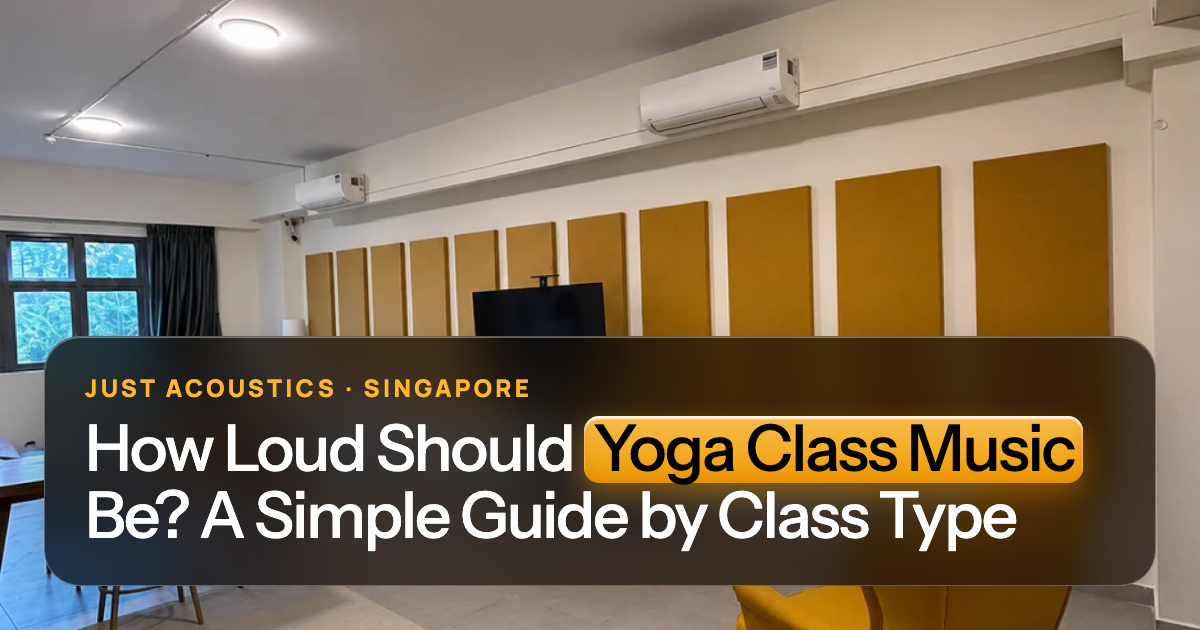
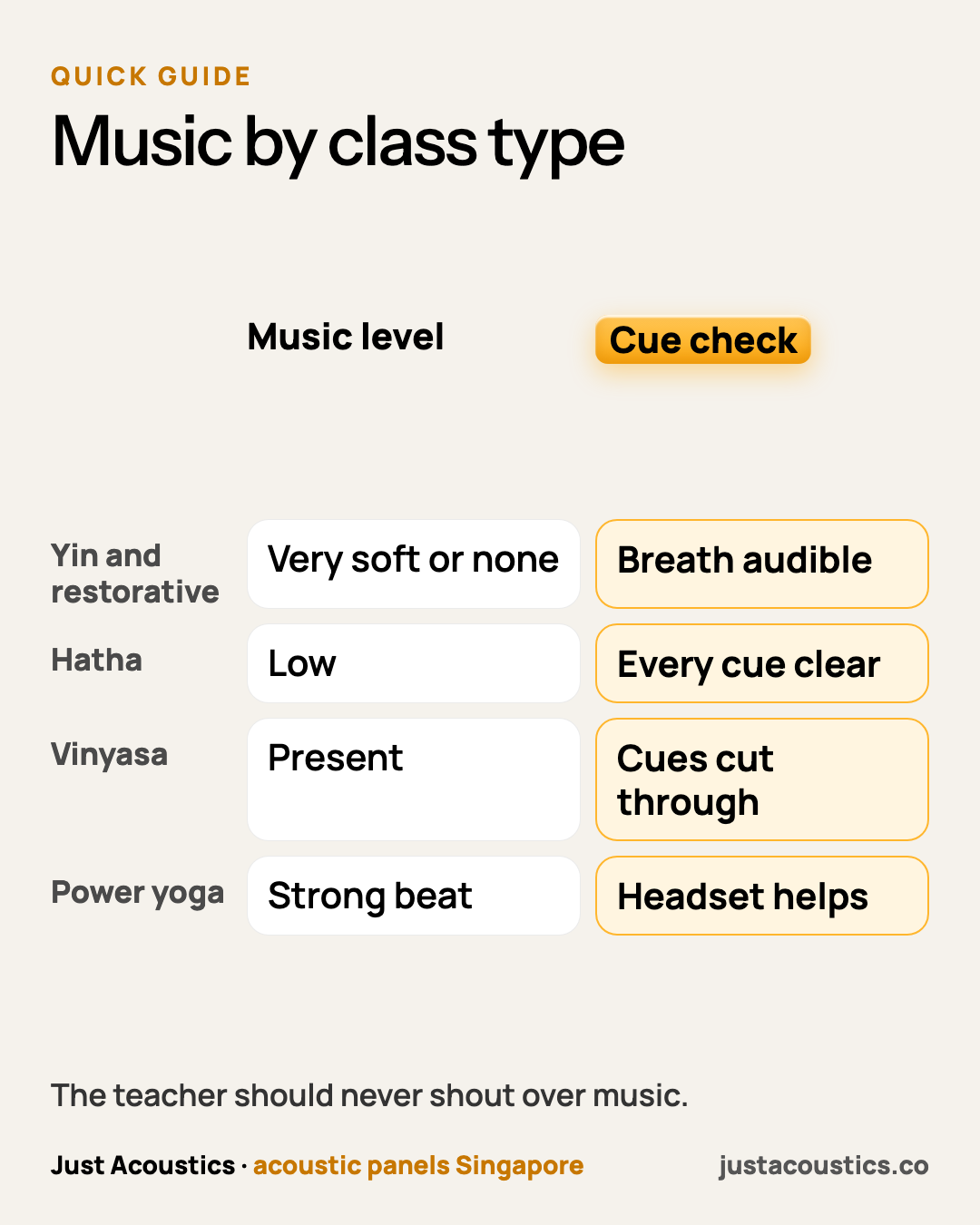
Quick answer: A simple rule: music should never make the teacher raise their voice. In yin and restorative, music should sit quietly in the background. In vinyasa and power classes, it can be more present but cues must still be clear. If you cannot find a volume that works, the room is probably echoing, and panels fix that.
Key takeaways
- Music should never make the teacher shout.
- Quiet for yin, more present for power.
- If no volume works, fix the echo.
What is the simplest test?
Stand at the back of the room and ask: can I hear the teacher clearly at a normal voice? If not, the music is too loud or the room echoes. Try the test with the room full, since people change the sound. See how to fix bad acoustics in a room.
How loud for yin and restorative?
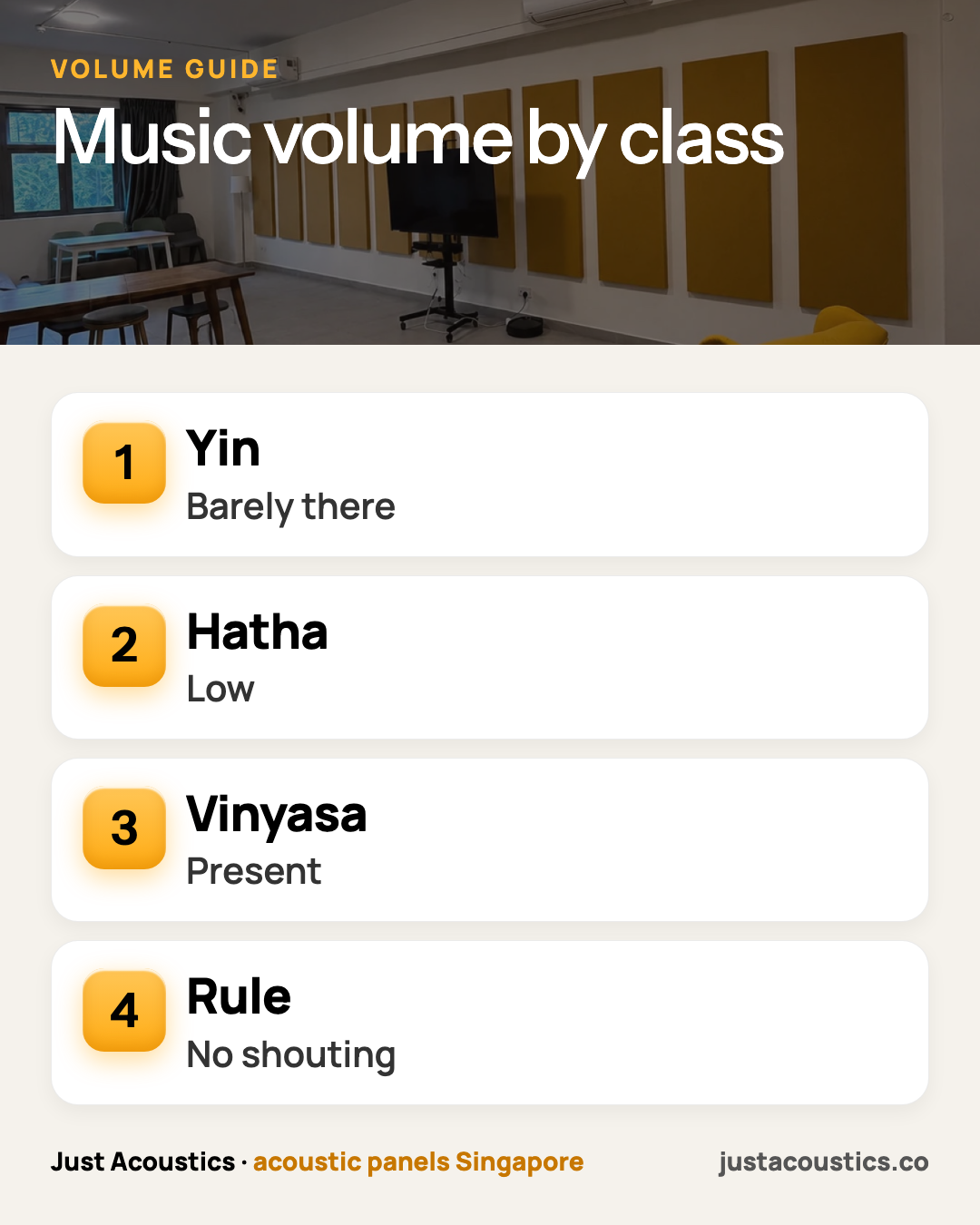
Soft enough that students can hear their own breath. Music can be a gentle backdrop or left out entirely. Silence between tracks is fine. Any echo is very obvious in these classes.
Not sure what your room needs? Send us a photo on WhatsApp or request a free quote. We'll tell you how many panels, where they go and the price. See our gym and studio acoustic panels and recent projects.
How loud for hatha?
Low to moderate, with music behind the teacher, not over them. Students should hear every alignment cue without straining. Turn it down when giving detailed instructions.
How loud for vinyasa and power yoga?
More present, with a clear beat to move to. Cues must still cut through. A headset mic at low level helps in larger rooms. See gym acoustic treatment.
Why can't I find a good volume?
In an echoey room, music turns into a wash. Too low and it sounds thin; a bit higher and it covers the teacher. That is a room problem, not a volume problem. Panels let music sound full at a lower level. See do acoustic panels really work.
What does fixing the room cost?
A typical 8 × 6 m studio needs 16 to 24 panels, about S$2,960 to S$4,440 at S$185 each installed. Smaller rooms need fewer panels. We can confirm the count from a few photos of the room. See acoustic panel prices.
Should every teacher use the same level?
Agree a simple guide per class type, then let teachers adjust for class size. A full room soaks up more sound than an empty one, so the same setting sounds quieter. Mark the usual level on the amplifier so new teachers have a starting point.
What about neighbours?
Panels will not stop music reaching neighbours. They do not block sound through walls; sealed doors, solid walls or isolation work do that. Keeping the volume and bass low is the simple step you control. See acoustic treatment vs soundproofing.
What we see on real jobs
When no volume feels right, the real issue is usually the room. Fix that and the volume is easy to set.
Get a straight answer for your room
Send a photo or short video of your studio or gym floor on WhatsApp (+65 8930 1905), ideally during a class. We'll suggest where panels go, keep them clear of equipment and mirrors, and install outside class times.
WhatsApp us a photo · Request a free quote · See prices
Related reading
- Gym acoustic treatment
- Gym and studio acoustic panels
- Do acoustic panels really work?
- Where to place acoustic panels first
- Acoustic panel prices in Singapore
- Prices and installation
- Our projects
- Flexi™ acoustic panels (39 colours)
- Get a free quote
- Mirrors and Acoustic Panels: Where Each Goes in a Studio
- Best Acoustic Panel Colours for Yoga and Wellness Studios
- Opening a New Fitness Studio: Acoustics Checklist