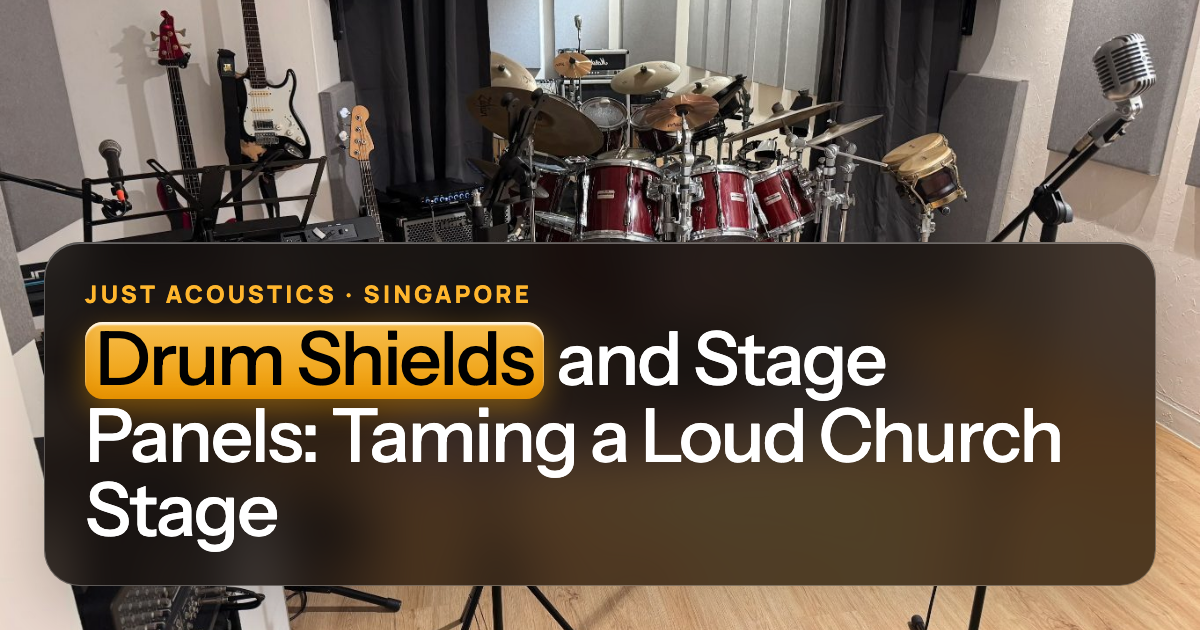
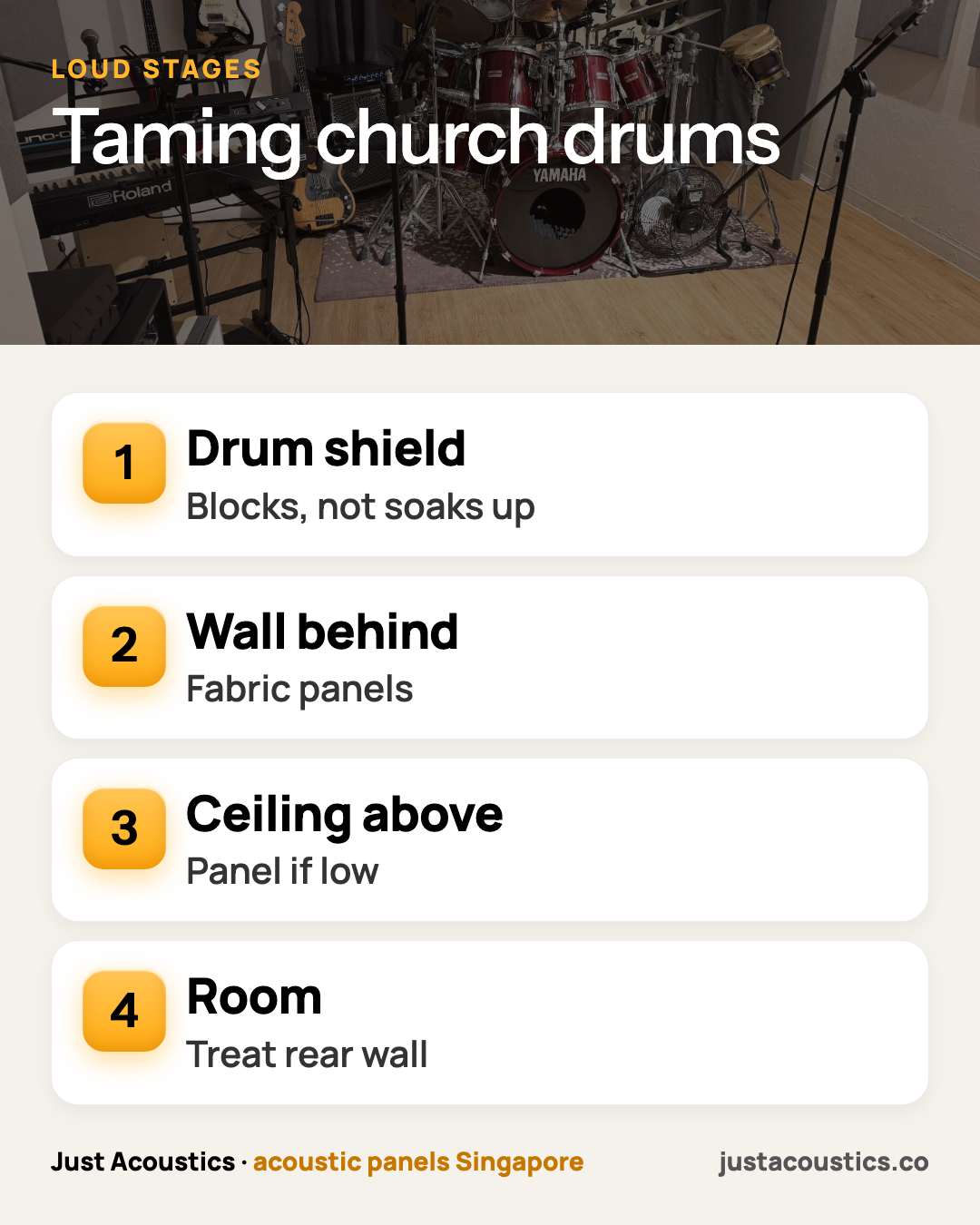
Quick answer: Drums are the loudest instrument on most church stages, and in an echoey hall they swamp the singers. A clear drum shield blocks some direct sound towards the front rows, but it reflects sound back to the drummer and up to the ceiling. Fabric panels on the wall behind the drums and on the ceiling above soak up that bounce. Room panels on the rear and side walls then stop the whole mix smearing.
Key takeaways
- A drum shield blocks direct sound, not echo.
- Panels behind and above the kit soak up the bounce.
- Treat the room too, or the mix still smears.
What does a drum shield actually do?
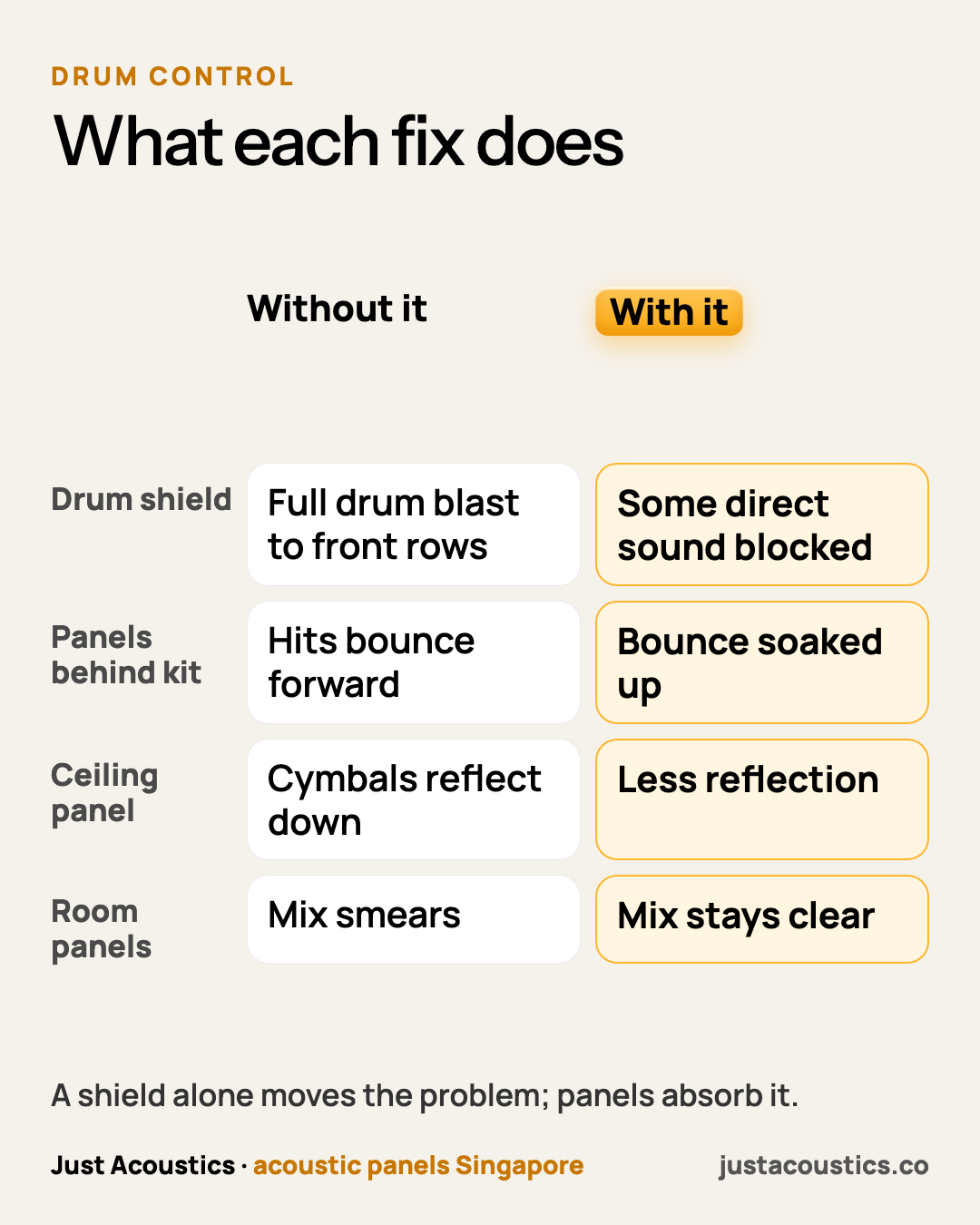
A clear acrylic shield sits in front of the kit and blocks some of the direct sound to the front rows. It does not soak up sound; it bounces it. That sound goes back to the drummer, to the wall behind, and up to the ceiling. Without treatment there, the shield only moves the problem.
Why put panels behind the drums?
The wall behind the stage is often hard, and it bounces drum hits forward into the hall. Fabric panels on that wall soak up much of the bounce. This makes the kit sound tighter and helps the drummer hear clearly. In small halls this one wall makes a noticeable difference.
Not sure what your room needs? Send us a photo on WhatsApp or request a free quote. We'll tell you how many panels, where they go and the price. See our church acoustics and recent projects.
Do we need a ceiling panel over the kit?
If the ceiling over the stage is low or hard, yes, it helps. Cymbals and snare sound bounce straight off it into the congregation. A panel or two hung above the kit reduces that. Ceiling panels are always fixed mechanically, never glued. See ceiling panels vs wall panels.
What about fully enclosed drum booths?
Some churches use a booth with a roof and absorbent sides. It cuts drum volume in the hall a lot, but it is costly and the drummer can feel cut off. A shield plus treated walls and a moderate playing style is often enough. Talk to your drummer and sound team first.
Why treat the rest of the room too?
Even a well-controlled kit is loud in a bare hall, and every instrument competes with the echo. Panels on the rear and upper side walls stop the whole band blurring together. This lets the sound team run a lower volume overall. See church acoustic treatment in Singapore.
How much will it cost?
Stage wall treatment often needs a modest number of panels, similar to a small room, at S$185 each installed. A full hall of about 20 × 12 m needs around 152 to 206 panels, roughly S$28,000 to S$38,000. Starting with the stage wall and rear wall is a sensible first phase. See acoustic panel prices.
Bass and kick drum
Low bass is the hardest to control. Corner bass panels help in small rooms, but large halls rely on room-wide treatment and good speaker setup. Panels do not stop bass travelling through walls and floors to other rooms.
Practice nights
A treated stage also makes weeknight rehearsals clearer for the team. Musicians hear each other without turning up. Panels do not stop sound reaching nearby rooms; that needs solid doors, seals and building work.
What we see on real jobs
The wall behind the kit is often the quickest win. A home music studio we treated with corner bass panels and wall panels took only half a day.
Get a straight answer for your room
Send us a short video of your hall during a service or rehearsal on WhatsApp (+65 8930 1905). We'll suggest where to start, how to phase it and what it costs, and schedule work around your services.
WhatsApp us a photo · Request a free quote · See prices
Related reading