.svg?w=384)
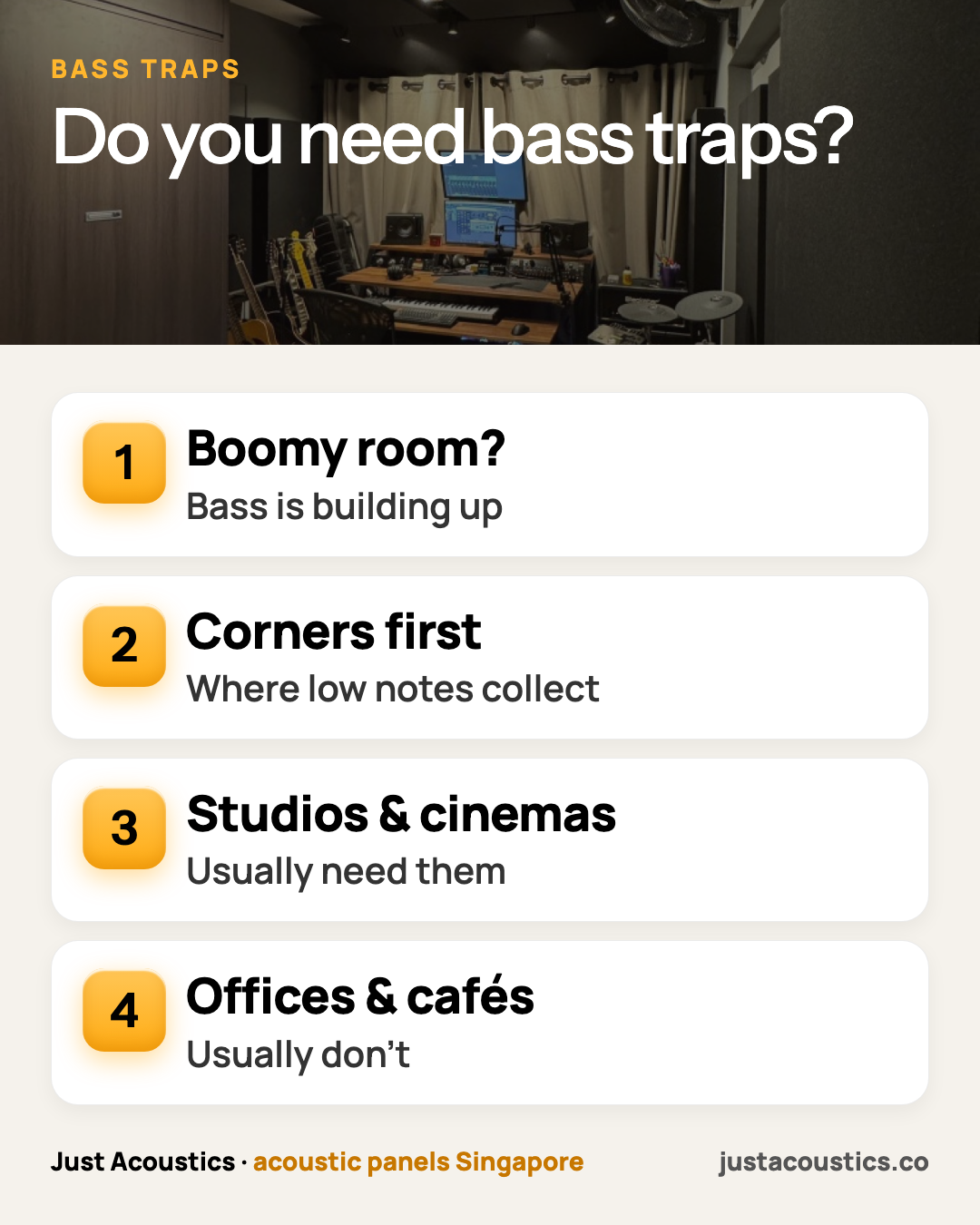
Quick answer: You need bass traps (thick corner panels that soak up deep, boomy sound) if your room sounds boomy, some bass notes are much louder than others, or mixes have unpredictable low end. That is common in small Singapore bedrooms used as studios, home cinemas and drum rooms. Bass traps are thick absorbers placed in corners, where deep, bassy sounds build up. Offices, restaurants and classrooms usually don't need them.
Key takeaways
- Bass builds up in corners, especially in small rooms.
- Bass traps go in corners; panels go at reflection points.
- Speech rooms rarely need bass traps; music rooms usually do.
What does a bass trap do?
It soaks up deep, bassy sounds that normal panels can't. Low notes build up where walls meet, so traps are placed in corners (wall-wall and wall-ceiling), ideally floor to ceiling. The result is tighter, more even bass.
Who needs bass traps?
- Home studios and mixing rooms.
- Home cinemas with subwoofers.
- Drum, band and piano rooms.
- Small, square bedrooms that sound boomy.
Not sure what your room needs? Send us a photo on WhatsApp or request a free quote. We'll tell you how many panels, where they go and the price. See our acoustic panels for homes and recent projects.
Who doesn't?
Most offices, restaurants, classrooms and churches: the problem is speech clarity. Standard panels fix that. Speech sits in the mid range, not the deep bass. See are thicker panels better?.
Where should bass traps go?
Front corners behind the speakers first, then rear corners, then wall-ceiling junctions. Pair with panels at the reflection points. Keep speakers a little away from the corners too. See home studio treatment.
What do we use?
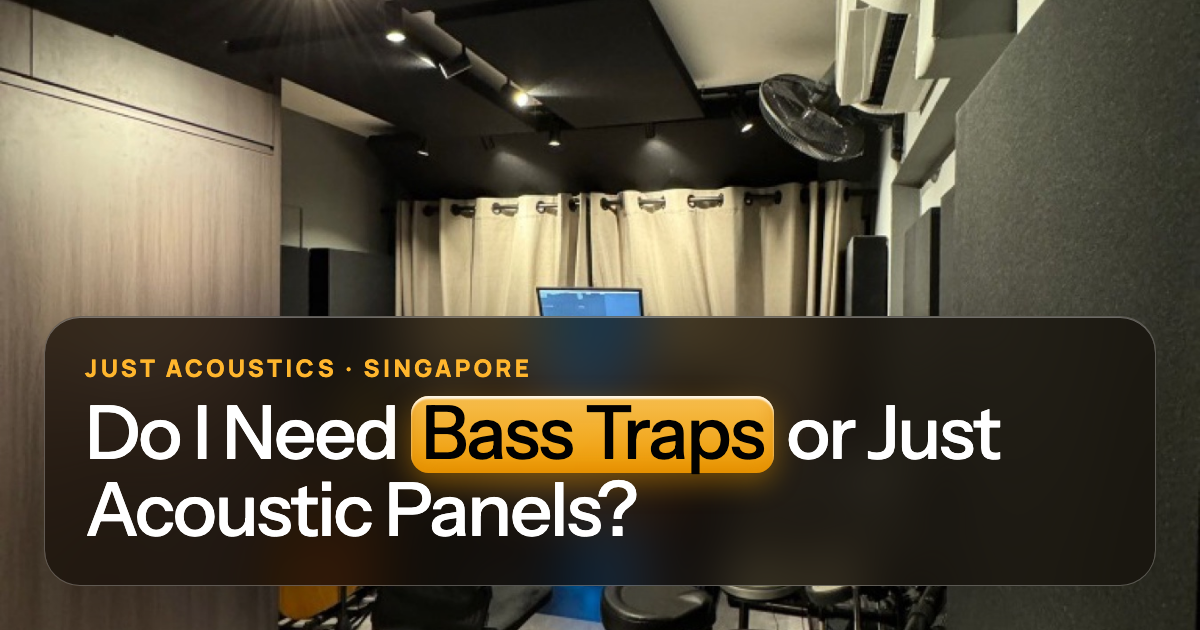
Our Soothe™ bass trap panels are made for corners in home studios and cinemas. One home music studio we treated got corner bass panels plus wall panels in black fabric. The install took half a day.
Quick test for bass build-up
Play a slow bass line or a low test tone sweep at your listening spot, then walk around the room. If some notes jump out loudly in corners or at your seat while others vanish, you have bass build-up, and traps will help. Try it again after the traps go in to hear the change.
What we see on real jobs
A desk in a small square room with speakers near the corners is a classic cause of boom. Corner bass traps plus panels at the side walls fix far more than adding more panels on the walls. One home music studio we did had corner bass panels and wall panels in black fabric, installed in half a day.
Get a straight answer for your room
WhatsApp a photo of the room (+65 8930 1905) and tell us what you use it for: calls, TV, music or mixing. We'll suggest a layout, a colour and a price, including no-drill options where your walls allow.
WhatsApp us a photo · Request a free quote · See prices
Related reading