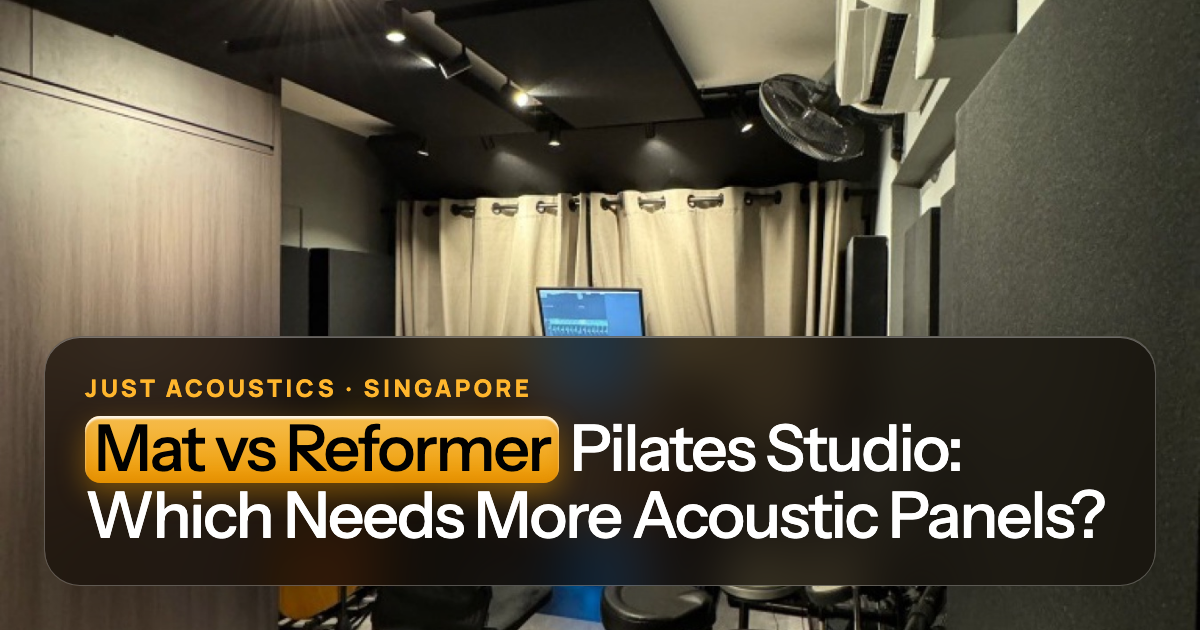
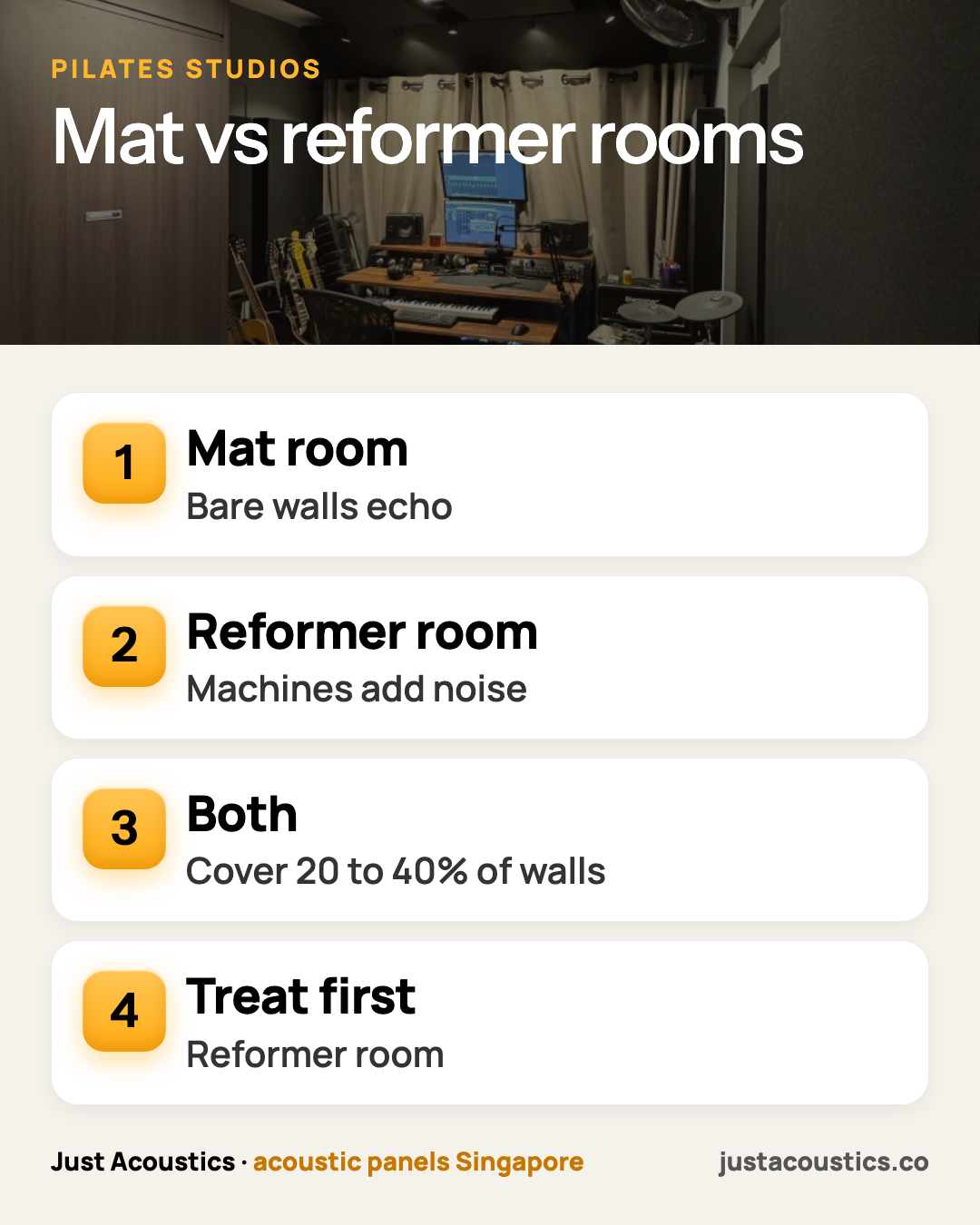
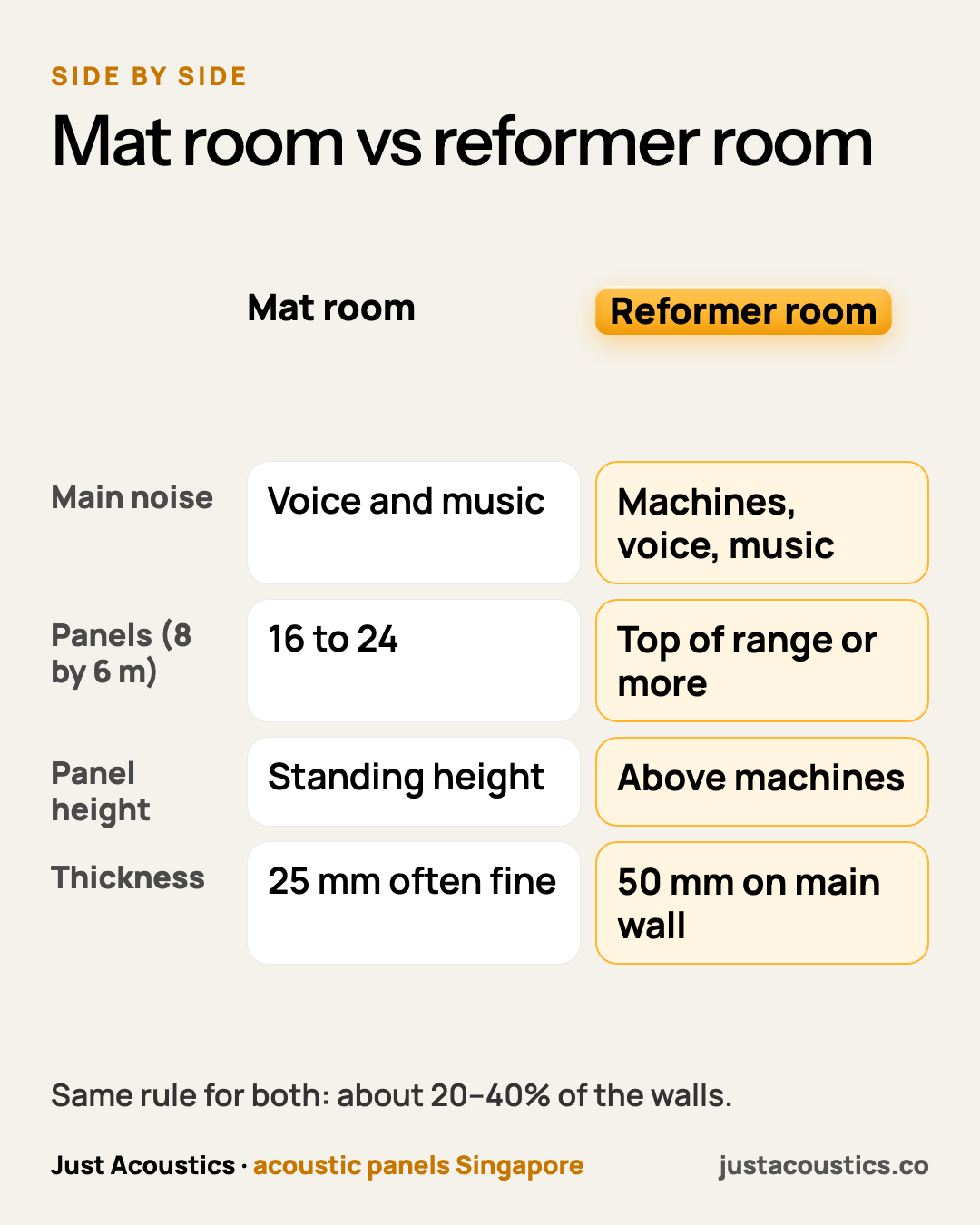
Quick answer: A reformer room usually needs more acoustic treatment than a mat room, because the machines add constant mechanical noise. A mat room is quieter, but its big bare walls and hard floor still make the instructor sound echoey. Both follow the same rule: cover about 20 to 40 percent of the walls. A mat room of 8 by 6 m usually needs 16 to 24 panels; a reformer room of the same size sits at the top of that range or above.
Key takeaways
- Reformer rooms are louder and need more panels.
- Mat rooms still echo because they are so bare.
- Both need about 20–40% of the walls covered.
Why does a mat room echo?
Mat rooms are mostly empty: a hard floor, mirrors, plain walls and little furniture. With nothing soft to stop it, the instructor voice bounces around. Calm cues for breathing get lost in the ring. Mats on the floor help a little, but not enough.
Why is a reformer room louder?
The machines make sound all class long. Springs click, carriages roll and footbars knock. That adds a steady layer of noise on top of voice and music, so the echo builds faster.
Not sure what your room needs? Send us a photo on WhatsApp or request a free quote. We'll tell you how many panels, where they go and the price. See our gym and studio acoustic panels and recent projects.
How many panels does each need?
For an 8 by 6 m room, a mat studio usually needs 16 to 24 panels. A reformer studio of the same size often needs the top of that range, or a few ceiling panels on top. The exact count is confirmed from photos. See how many panels you need.
What does each cost?
At S$185 per panel installed, 16 panels cost about S$2,960 and 24 panels about S$4,440. The difference between mat and reformer is usually a handful of panels, not a different budget. Standard fixings are included. See acoustic panel prices.
Where do panels go in each room?
In a mat room, place panels on the wall facing the instructor and on the side walls at standing height. In a reformer room, keep panels above machine height so straps and springs never touch them. In both, leave the mirror clear. See where to place panels first.
Can one studio share both?
Yes. Some studios run mat and reformer classes in rooms side by side. Treat the reformer room first, as it is usually louder, then the mat room. Panels between rooms do not stop sound passing through the wall.
Is the yoga advice the same?
Mostly. A mat Pilates room behaves like a yoga room. Read our guide to yoga and Pilates studio sound for more on calm classes.
Which thickness for each room?
25 mm panels suit most mat rooms. In a reformer room, 50 mm panels on the main wall soak up a bit more. Both thicknesses come in the same sizes and 39 colours, so the rooms can still match.
What we see on real jobs
A bare mat room looks like the bigger problem, but a reformer room is usually louder during class. Listen to both rooms in a full class before you decide.
Get a straight answer for your room
Send a photo or short video of your studio or gym floor on WhatsApp (+65 8930 1905), ideally during a class. We'll suggest where panels go, keep them clear of equipment and mirrors, and install outside class times.
WhatsApp us a photo · Request a free quote · See prices
Related reading
- Gym acoustic treatment
- Gym and studio acoustic panels
- How many acoustic panels do I need?
- Acoustic panel prices in Singapore
- Acoustic treatment vs soundproofing
- Prices and installation
- Our projects
- Flexi™ acoustic panels (39 colours)
- Get a free quote
- Yoga and Pilates Studio Acoustics: Calm Sound for Calm Classes
- Spin and HIIT Studios: Loud Music Without the Harsh Echo
- How Much Do Acoustic Panels Cost for a Gym?