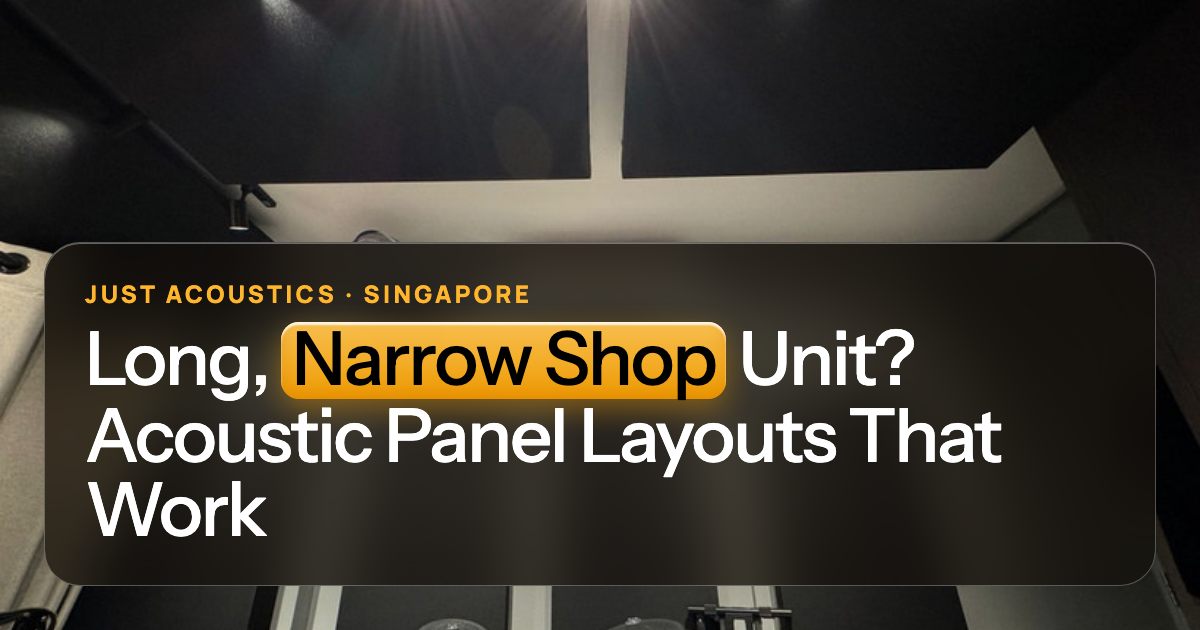
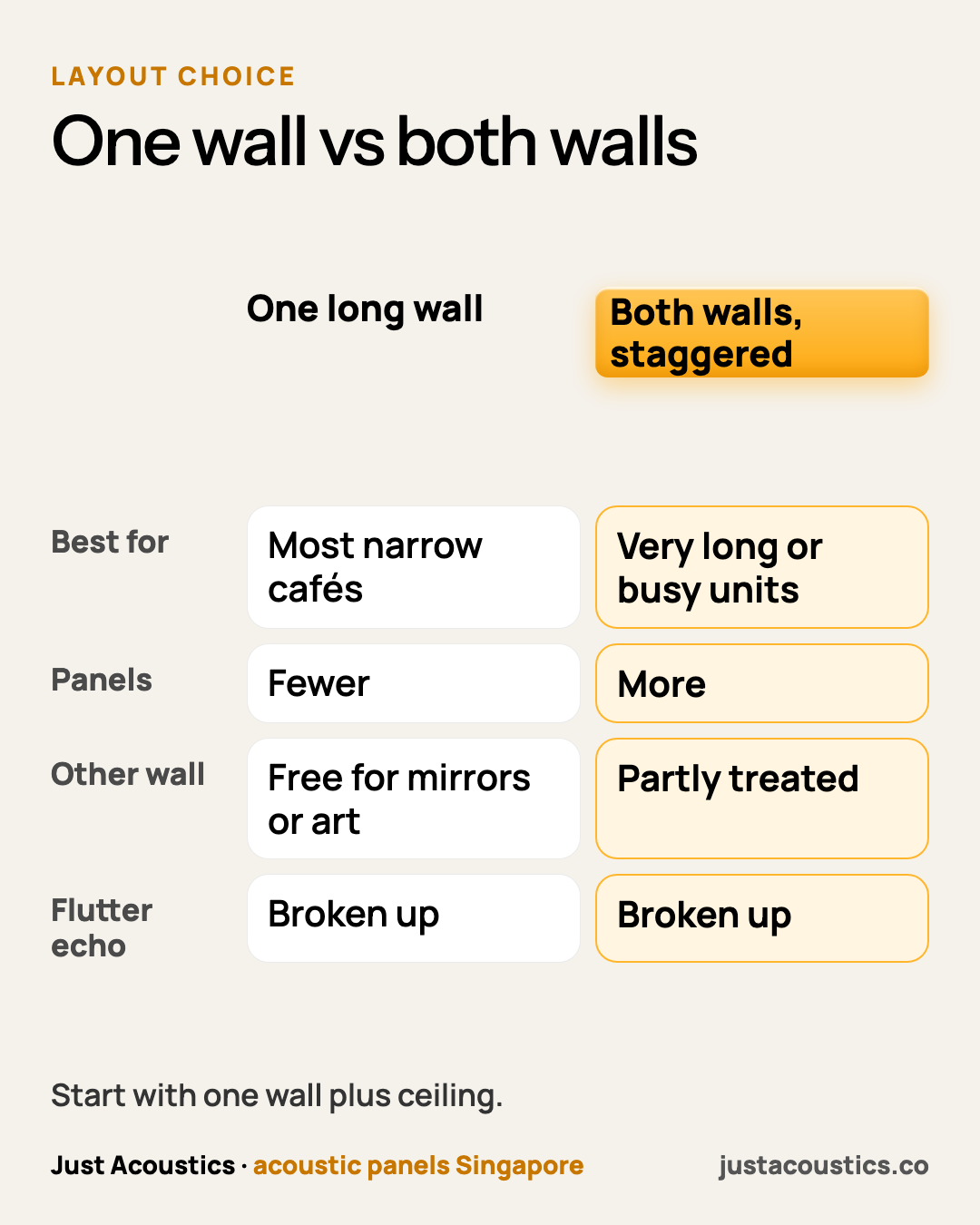
Quick answer: Long, narrow shop units, like many shophouses and mall units, echo because sound bounces between two close side walls. You usually do not need to cover both. A row of panels along one long wall at seat to head height, plus ceiling panels along the centre, does most of the work. If you treat both walls, stagger the panels so they do not face each other directly.
Key takeaways
- Two close parallel walls cause flutter echo (a fast, ringing echo between two bare walls).
- One long wall treated often fixes it.
- Stagger panels if you treat both walls.
Why do narrow units echo so much?
When two hard walls face each other closely, sound pings back and forth between them. This makes a quick buzzy ring called flutter echo. Narrow units also have long sight lines, so noise travels the whole length. See how to fix bad acoustics in a room.
Layout 1: one long wall
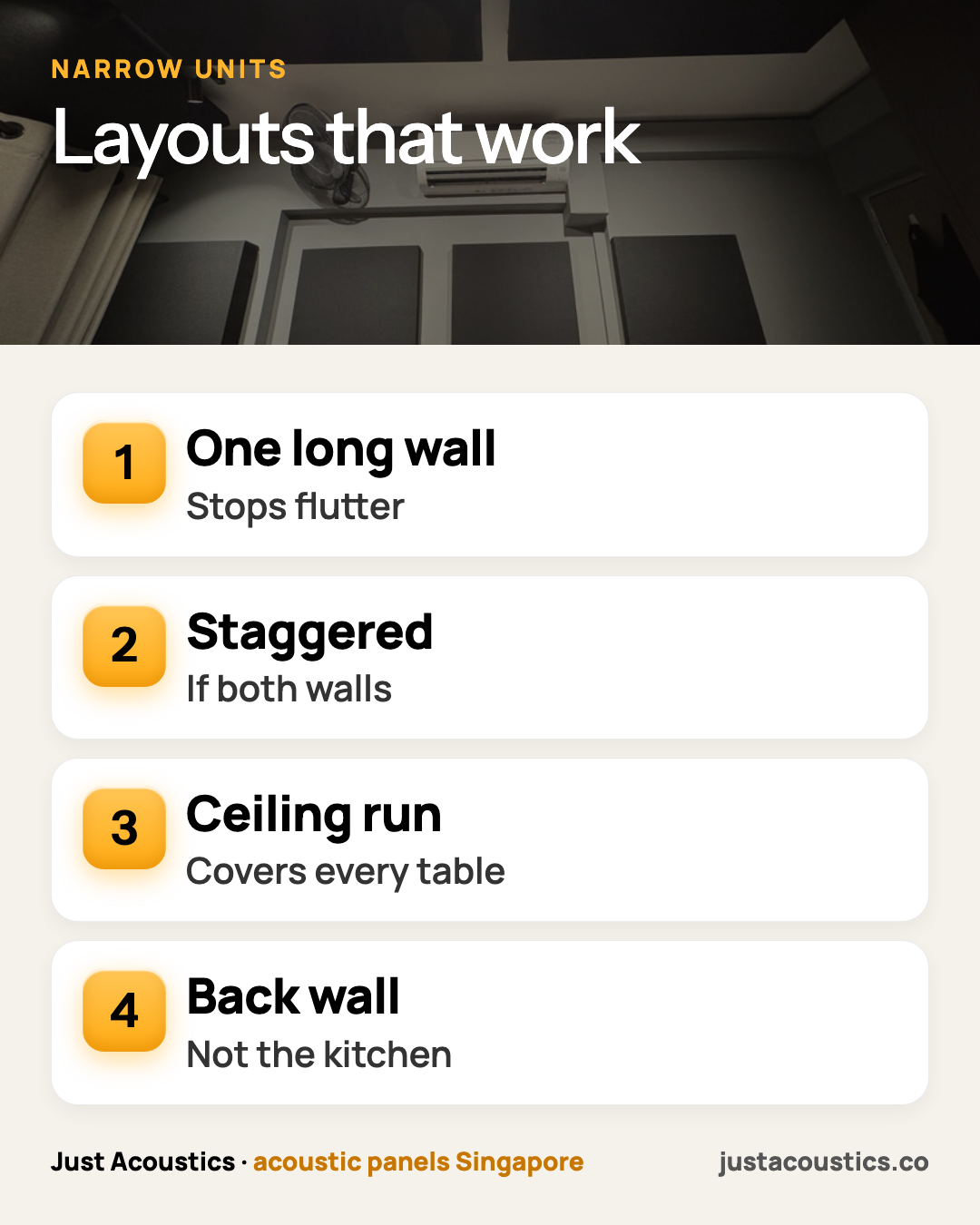
Run a row of 1200 × 600 or 1800 × 600 mm panels along one long wall, from about seat height up. This breaks the ping-pong between the walls. It also leaves the other wall free for mirrors, art or a feature. It is often the simplest and cheapest fix.
Not sure what your room needs? Send us a photo on WhatsApp or request a free quote. We'll tell you how many panels, where they go and the price. See our restaurant acoustic panels and recent projects.
Layout 2: staggered on both walls
If the unit is very long or busy, treat both walls but offset the panels. A panel on one side faces bare wall on the other. This spreads absorption (how much sound gets soaked up) without making the room feel boxed in.
Layout 3: a ceiling run
A line of ceiling panels or clouds down the centre of the room covers every table. It works well in shophouses with high ceilings. Combine it with one treated wall for busy dining rooms. See ceiling panels vs wall panels.
Do not forget the back wall
The far end wall faces the whole room and reflects sound straight back. A few panels there help, as long as it is not the kitchen wall with heat and steam. Keep fabric away from the kitchen pass and sinks.
How many panels and what cost?
Use the rule of about 20 to 40 percent of wall area. A small 30-seat café usually needs 10 to 18 panels, about S$1,850 to S$3,330 installed. A 10 × 6 m dining room usually needs 28 to 38 panels, about S$5,180 to S$7,030. See how many acoustic panels you need.
Mirrors as a trick
Mirrors can make a narrow café look wider. Keep the mirror wall and treat the opposite one. Mirrors reflect sound like glass, so the treated wall matters even more.
Seating along the wall
Banquettes along one long wall pair well with panels above them. Guests lean back near soft fabric. Start the panels just above the seat back so they do not get rubbed.
What we see on real jobs
Shophouse cafés often have this shape. A treated long wall usually makes a clear difference straight away.
Get a straight answer for your room
WhatsApp us (+65 8930 1905) a photo of your dining room, ideally taken during service, and tell us when it gets loudest. We'll come back with a ceiling-and-wall plan and a price. Ask us about installing outside opening hours.
WhatsApp us a photo · Request a free quote · See prices
Related reading
- How to fix bad acoustics in a room
- Where to place acoustic panels first
- How many acoustic panels do I need?
- Acoustic treatment for restaurants
- Restaurant acoustic panels
- Prices and installation
- Our projects
- Flexi™ acoustic panels (39 colours)
- Get a free quote
- Modern Kopitiam and Hawker-Style Eateries: Keep the Buzz, Cut the Clatter
- Bakery Cafés With Queues: Calming the Counter and Dining Area