.svg?w=384)

Quick answer: High-ceiling cafés are echoey because the bigger volume of air lets sound travel and bounce for longer, and tall rooms usually have hard finishes like exposed concrete and glass. The fix is to treat the ceiling area with suspended clouds or vertical baffles, plus panels on long walls. Wall panels alone rarely fix a tall room.
Key takeaways
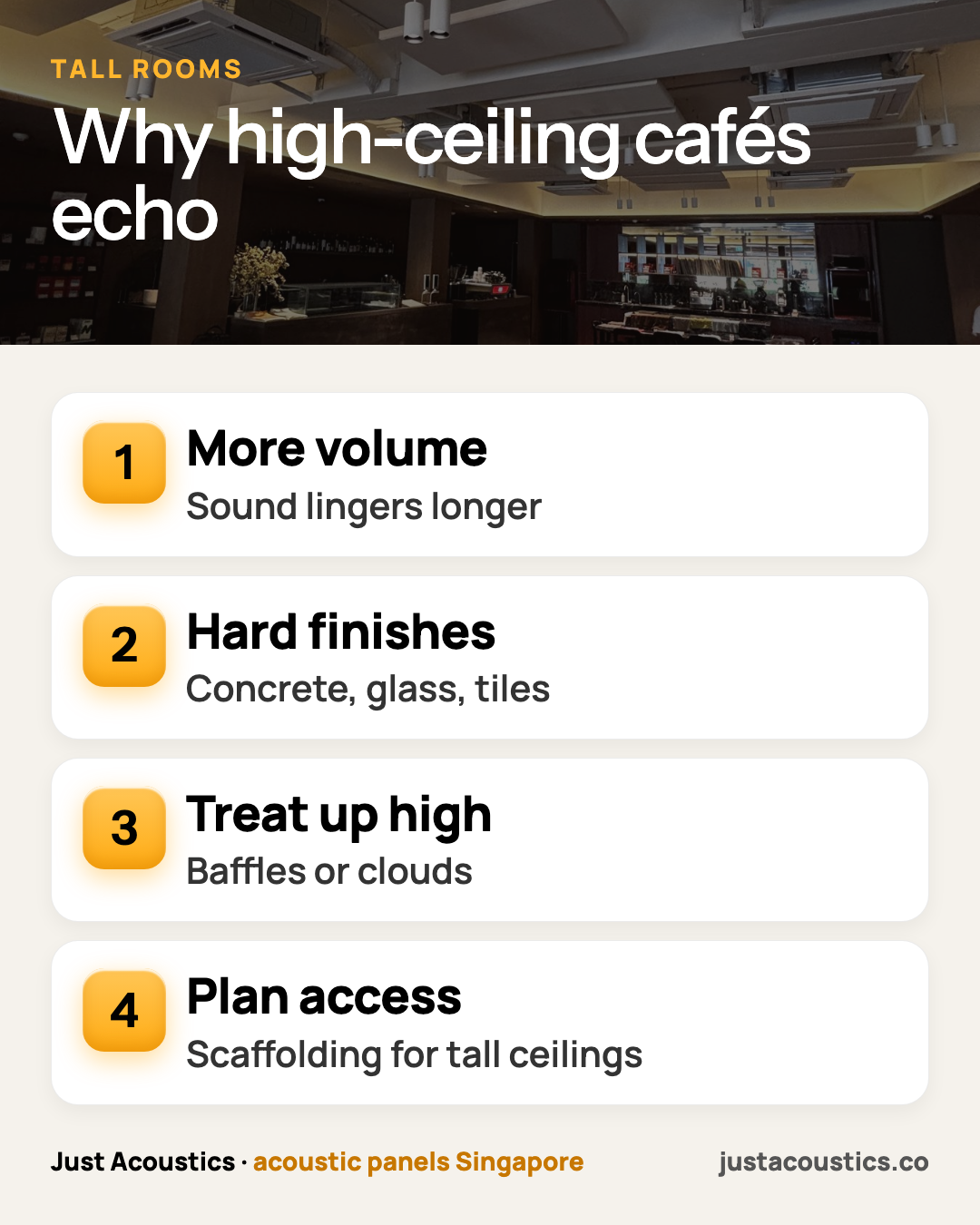
- More volume = sound lingers longer.
- Treat high up: clouds or baffles, not only walls.
- Plan access: high ceilings usually need scaffolding to install.
Why do tall rooms sound worse?
Echo time grows with room volume. A double-height café holds sound far longer than a normal-height one with the same finishes. Add exposed concrete, tiles and glass shopfronts, and the room rings. More on the measure: what is RT60?.
What fixes a high-ceiling café?
- Vertical baffles hung in rows between services.
- Suspended clouds over seating.
- Wall panels on long walls, high and low.
See suspended vs flat-mounted ceiling panels.
Not sure what your room needs? Send us a photo on WhatsApp or request a free quote. We'll tell you how many panels, where they go and the price. See our restaurant acoustic panels and recent projects.
Do I need scaffolding?
Often, yes. Ceiling work above about 3.5–4 m needs a stable platform for safe, accurate installation. Scaffold is quoted separately, so factor it into timing and cost.
Can it still look industrial?
Yes. Black baffles disappear against a black ceiling; raw-tone fabrics suit industrial interiors. With 39 fabric colours, you can match the panels to your concrete, timber or brand colours.
What about the music?
Speakers mounted high in a tall room spray sound onto the ceiling. Aim them down at seating and keep them out of corners; it helps the treatment work better. Once the echo is down, you can often run the music a little quieter.
Shophouse cafés
Many Singapore cafés are in shophouses with tall ceilings, long narrow plans, plaster walls and tiled floors. The long side walls face each other along the whole room, so flutter echo (a fast, ringing echo between two bare walls) is common. Treat one long wall along much of its length, add clouds or baffles overhead, and keep the front glass clear.
What we see on real jobs
Tall cafés are where wall-only treatment disappoints most. The sound keeps bouncing off the ceiling. In those rooms we put most of the budget overhead and use walls to finish the job.
Get a straight answer for your room
WhatsApp us (+65 8930 1905) a photo of your dining room, ideally taken during service, and tell us when it gets loudest. We'll come back with a ceiling-and-wall plan and a price. Ask us about installing outside opening hours.
WhatsApp us a photo · Request a free quote · See prices
Related reading