.svg?w=384)
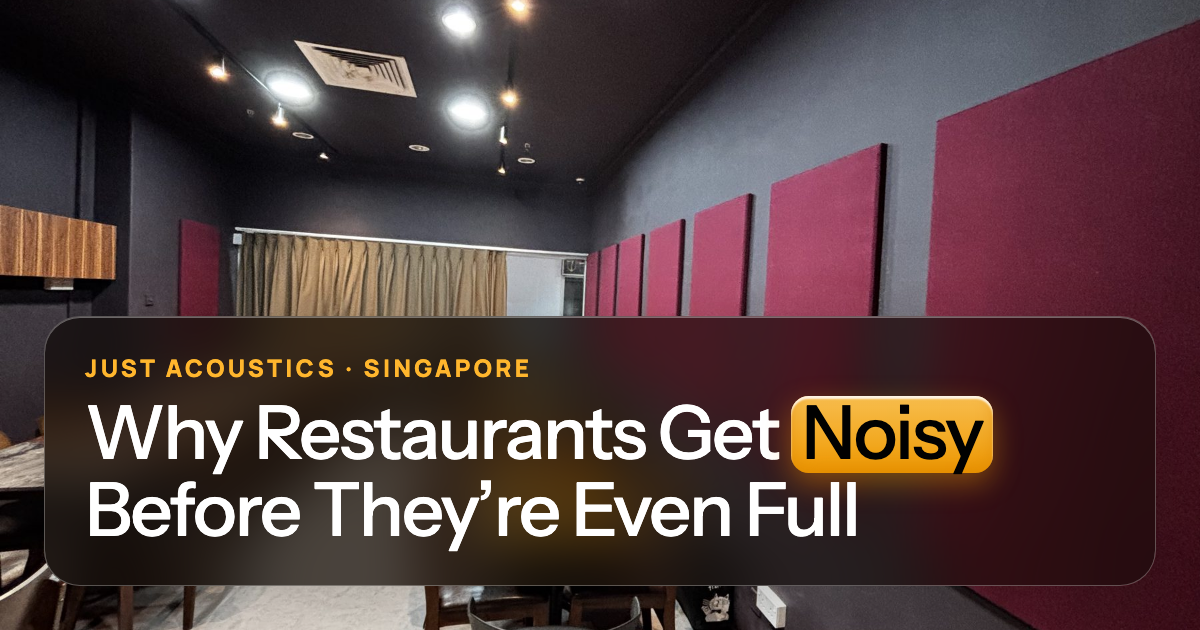
Quick answer: Restaurants get noisy before they are full because hard surfaces bounce every voice back into the room, and guests raise their voices to be heard over the echo. That makes others talk louder too, so noise snowballs from about half capacity. Soaking up the bounce with ceiling and wall panels breaks the cycle.
Key takeaways
- Echo + louder voices = a noise spiral (the Lombard effect).
- It starts well before full capacity in hard-finished rooms.
- Absorption (how much sound gets soaked up) breaks the spiral; quieter music alone doesn’t.
What is the Lombard effect?
When it's hard to hear, people automatically speak louder. In a reflective dining room, every table does this at once. Each table's louder voice adds to the echo, so the next table goes louder still. That's why noise seems to jump suddenly rather than rise gradually.
Why does it start at half capacity?
With a few tables, the echo is noticeable but conversations still work. Around half full, enough voices overlap that guests begin to strain, and the spiral starts. In very hard rooms it can start with only a few tables.
Not sure what your room needs? Send us a photo on WhatsApp or request a free quote. We'll tell you how many panels, where they go and the price. See our restaurant acoustic panels and recent projects.

What breaks the spiral?
Soaking up sound so it doesn't keep bouncing: ceiling panels first, then one of each pair of facing walls, then soft finishes. Guests then talk normally, so there's less noise to bounce. Quieter music alone doesn't break it, because the echo is still there. See what actually fixes a loud restaurant.
Does lowering the music help?
A little, and it's worth doing once the room is treated. In an bare room, quieter music just makes the guest noise more obvious. Treat the ceiling and walls first, then set the music to suit the room.
How to spot it in your restaurant
Watch for these on a busy night: guests leaning across the table, staff repeating orders, the music creeping up, and groups leaving earlier than usual. If you see them before the room is full, the room is the problem. A clap that rings in the empty room before opening is another sign.
What size of improvement to expect
Treatment won't make a busy restaurant silent, and it shouldn't. What changes is that the room stops escalating: conversation stays possible at normal volume as tables fill, and the late-evening roar doesn't build. That's what guests and staff notice.
What we see on real jobs
A room that is "fine until 7.30" is showing the spiral starting. At Acqua E Farina on Keong Saik Road, we fitted custom ceiling clouds and wall panels, about 20+ panels in all, and guests can now talk without shouting.
Get a straight answer for your room
WhatsApp us (+65 8930 1905) a photo of your dining room, ideally taken during service, and tell us when it gets loudest. We'll come back with a ceiling-and-wall plan and a price. Ask us about installing outside opening hours.
WhatsApp us a photo · Request a free quote · See prices
Related reading