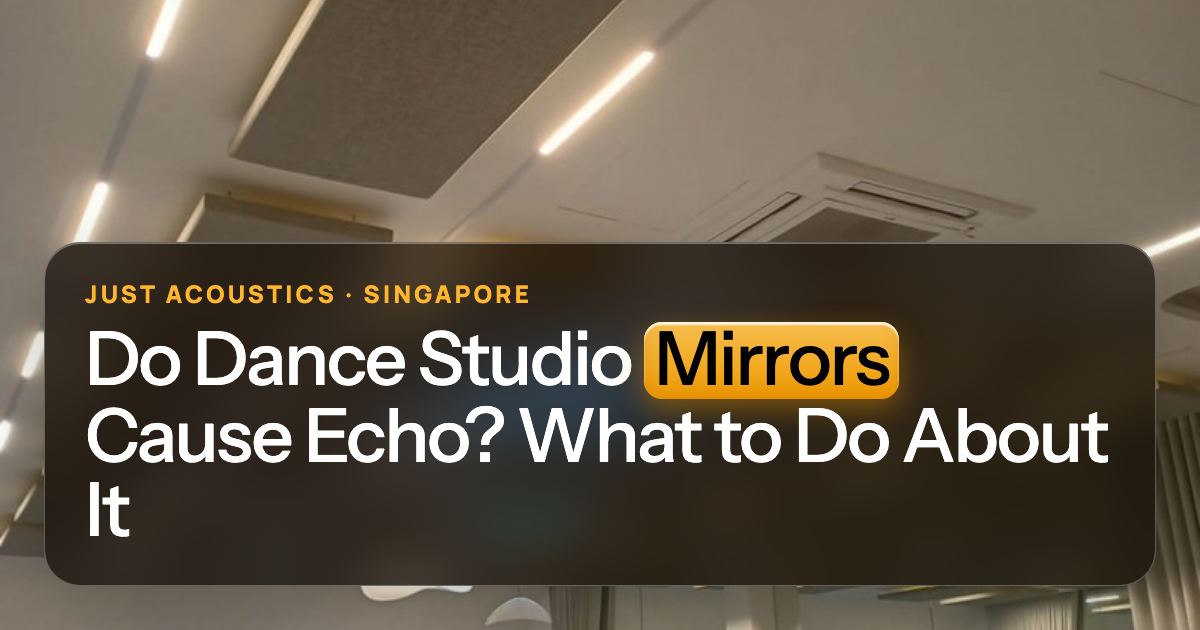
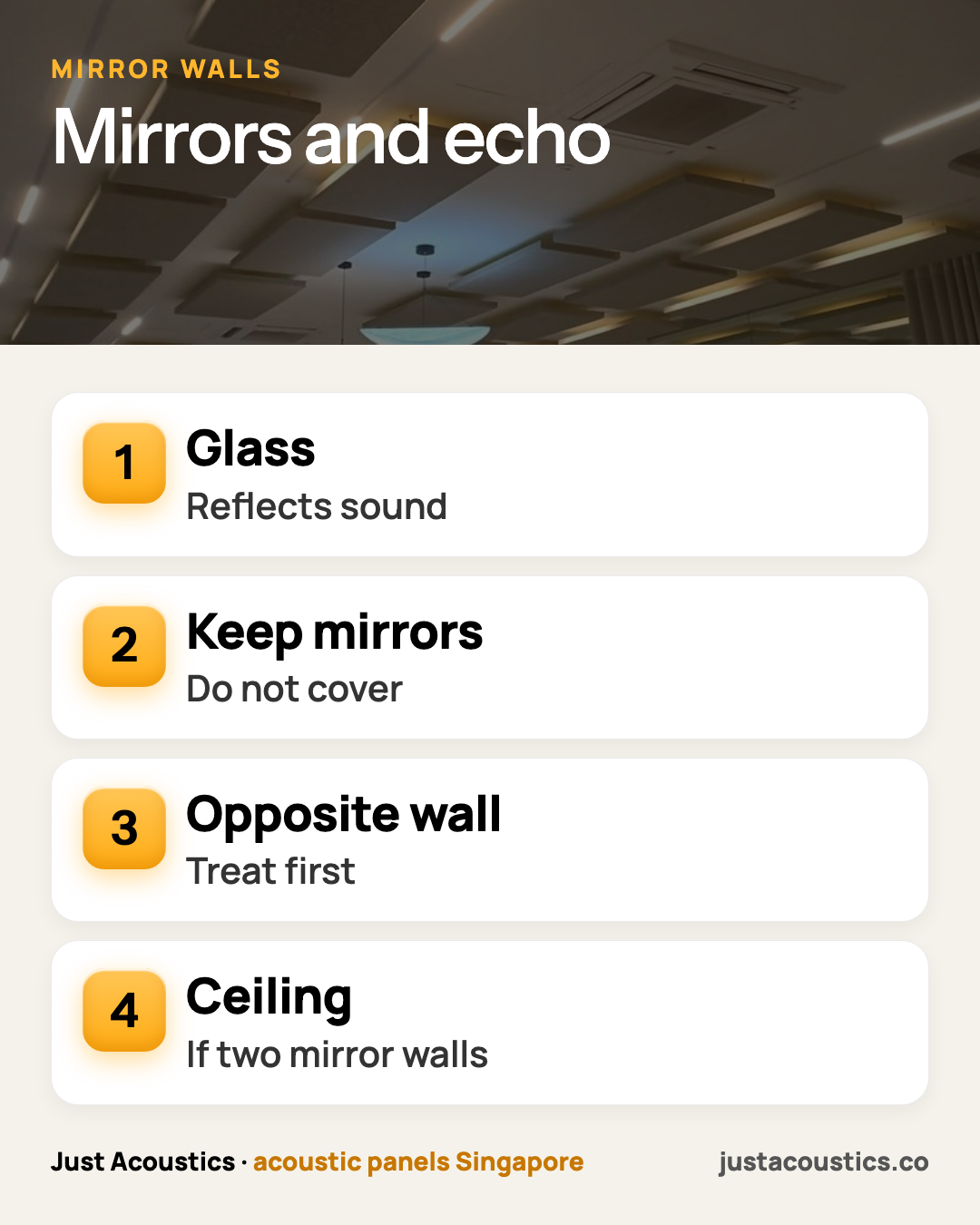
Quick answer: Yes. A full mirror wall is hard, flat glass, so it reflects almost all sound back into the studio. You should not cover the mirrors. Instead, put acoustic panels on the wall facing the mirrors, the upper side walls and the ceiling. That stops sound bouncing back and forth. An 8 × 6 m studio usually needs 16 to 24 panels, about S$2,960 to S$4,440.
Key takeaways
- Mirror walls reflect almost all sound.
- Do not cover them; treat the opposite wall.
- 16 to 24 panels for an 8 × 6 m studio.
Why do mirrors add echo?
Mirrors are glass, and glass is one of the hardest surfaces in any room. Sound hits it and bounces straight back. When the opposite wall is also bare, sound flutters between the two. You hear it as a ringing or buzzy echo, especially with claps and counts.
Should we cover part of the mirror?
No. Dancers need the full mirror to check lines and timing. Panels on glass are also not ideal. It is much better to treat the other surfaces. See acoustic panels on glass walls.
Not sure what your room needs? Send us a photo on WhatsApp or request a free quote. We'll tell you how many panels, where they go and the price. See our acoustic panels for schools and recent projects.
Where should panels go instead?
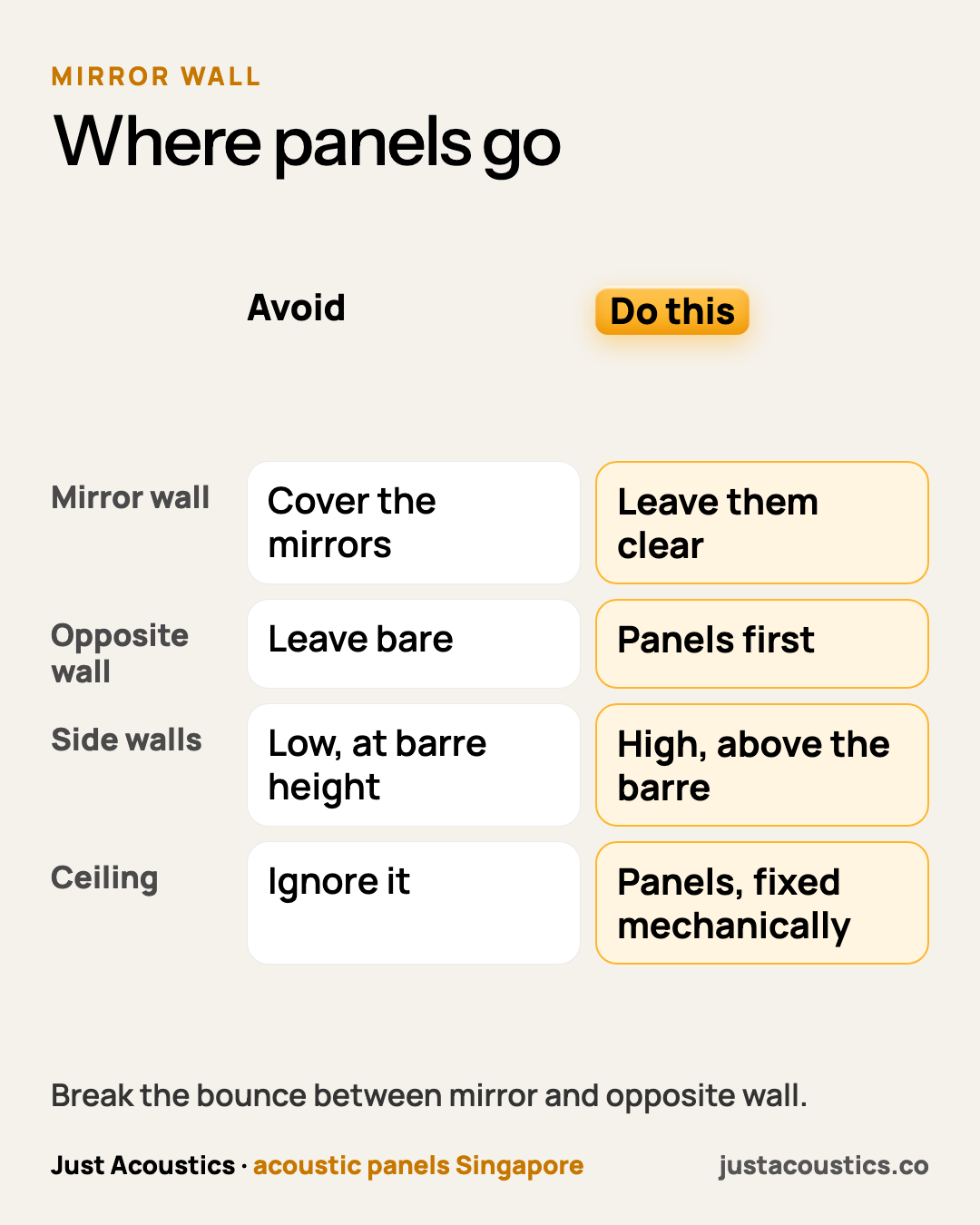
The most important spot is the wall directly facing the mirrors. This breaks the bounce between the two walls. Then add panels high on the side walls and on the ceiling. See where to place panels first.
Will panels show up in the mirror?
Yes, the wall behind dancers is what they see in the mirror. Pick a calm colour that does not distract. Dark grey, charcoal or a soft neutral works well. With 39 fabric colours, you can match your studio. See choosing panel colours.
How many panels and how much?
An 8 × 6 m studio usually needs 16 to 24 panels. At S$185 each installed, that is about S$2,960 to S$4,440. Most of the panels go on the wall facing the mirrors and the ceiling.
What if both long walls have mirrors?
Some studios have mirrors on two walls. Then the ceiling becomes the main spot for panels, plus the short end walls. Ceiling panels are always fixed mechanically. Start with a free virtual assessment by phone or WhatsApp; a site visit is usually free when the project is a good fit. See what happens during a site visit.
Flutter echo test
Stand in the middle of the studio and clap once. A fast buzzing ring means flutter echo (a fast, ringing echo between two bare walls) between the mirror and the opposite wall. Panels on the opposite wall break that bounce, so clap again after the install to hear the change.
Barres
Mount panels above barre height so dancers do not lean on or kick them. Fabric marks if hands and shoes rub it often. Panels higher on the wall still soak up echo well.
What we see on real jobs
In a dance studio, the wall facing the mirrors is the best place to start. Dancers see it in the mirror, so colour choice matters.
Get a straight answer for your room
Send a photo of the classroom or studio on WhatsApp (+65 8930 1905) with its rough size. We'll recommend panels for clearer lessons and schedule installation around your classes or school holidays.
WhatsApp us a photo · Request a free quote · See prices
Related reading
- Gym and studio acoustic panels
- Where to place acoustic panels first
- Choosing acoustic panel colours
- Acoustic panel prices in Singapore
- What happens during a site visit
- Acoustic panels for schools
- Prices and installation
- Our projects
- Flexi™ acoustic panels (39 colours)
- Get a free quote
- International School Acoustics: The Best Rooms to Treat First
- The Best Acoustic Panels for Classrooms and Tuition Centres
- Enrichment Centres in Malls: Noise Inside and Next Door